
Views: 0 Author: Site Editor Publish Time: 2026-08-10 Origin: Site


Zero Liquid Discharge mandates force chemical plants to process highly concentrated brines instead of discharging them. Facilities cannot rely on simple dilution or basic disposal methods anymore. You must treat these aggressive wastewater streams directly at the source.
Calcium chloride and magnesium chloride streams—often from alkylene oxide production, petrochemical refining, or desalination reject—create severe operational headaches. High boiling point elevation, rapid scaling, high viscosity, and aggressive corrosivity cause standard thermal separation systems to fail. Operators deal with plugged tubes, excessive downtime, and degraded heat transfer.
Treating these specific high-salt streams requires engineered thermal architecture. We evaluate the technical requirements for deploying a Multi-effect Evaporator system. We specifically look at integrating a Forced Circulation Evaporator to achieve continuous operation, high-purity salt recovery, and manageable operating conditions.
Boiling Point Elevation Dictates Design: CaCl2 and MgCl2 exhibit extreme boiling point elevations at high concentrations, requiring precise thermal driving force calculations across multi-effect stages to prevent system stalling.
Forced Circulation is Non-Negotiable for Crystallization: While falling film evaporators can handle initial pre-concentration, a Forced Circulation Evaporator is mandatory for the final concentration and crystallization stages to manage supersaturation and prevent tube scaling.
Metallurgy Defines Lifespan: High chloride concentrations at elevated temperatures necessitate premium metallurgy (e.g., Titanium, Super Duplex, or high-nickel alloys) to prevent Chloride Stress Corrosion Cracking (CSCC).
Energy vs. CAPEX Trade-off: Increasing the number of effects in a Multi-effect Evaporator improves steam economy (OPEX) but exponentially increases upfront capital costs (CAPEX) and footprint requirements.
Table of Contents
Treating industrial brines requires defining clear success criteria before equipment selection. You must establish baseline requirements for continuous operation under harsh conditions. Systems often need to handle feeds reaching up to 98% saturation while maintaining high-tonnage evaporation rates. The ultimate goals include massive Total Dissolved Solids reduction and achieving a final byproduct purity exceeding 99.7% salt recovery. Achieving these metrics requires a deep understanding of the fluid's behavior under thermal stress.

Calcium and magnesium salts possess exceptionally high solubility limits. This characteristic causes the boiling point of the solution to rise significantly above that of pure water. As the brine concentrates, the boiling point elevation increases non-linearly. A highly concentrated magnesium chloride solution can exhibit a boiling point elevation exceeding 20°C. This physical reality fundamentally alters how you must design the thermal transfer area.
High boiling point elevation severely reduces the effective temperature difference available for heat transfer. In a multi-stage thermal system, the vapor generated in one vessel heats the next. If the boiling point elevation consumes a large portion of the temperature gradient, subsequent vessels lack the thermal driving force required to boil the liquid. Consider a three-effect system operating with 120°C steam and a 50°C condenser. You have a total theoretical temperature difference of 70°C. If the boiling point elevation is 15°C per effect, you lose 45°C immediately. This leaves only 25°C of actual driving force distributed across all three heat exchangers. This phenomenon can completely stall the evaporation process if not rigorously calculated during the design phase. You must compensate by installing significantly larger heat transfer surfaces.
Salt Type | Concentration (wt%) | Approximate Boiling Point Elevation (°C) | Impact on Heat Transfer Area |
|---|---|---|---|
Sodium Chloride (NaCl) | 26% (Saturation) | ~9°C | Moderate increase required. |
Calcium Chloride (CaCl2) | 40% | ~14°C | Significant increase required. |
Magnesium Chloride (MgCl2) | 35% | ~22°C | Massive increase required; limits number of effects. |
Viscosity behaves unpredictably as these specific brines approach saturation. Magnesium chloride solutions become thick and syrupy at high concentrations. This elevated viscosity destroys fluid turbulence inside heat exchanger tubes. A drop in turbulence drastically lowers the heat transfer coefficient. When the Reynolds number falls, the fluid transitions from turbulent to laminar flow. In laminar flow, the liquid near the tube wall moves slowly, creating an insulating boundary layer that resists heat penetration.
Scaling agents complicate the concentration process. Industrial brines rarely contain pure chlorides. They carry co-existing scaling agents like silica and calcium sulfate. These impurities often reach their solubility limits before the target chlorides crystallize. Calcium sulfate exhibits inverse solubility, meaning it becomes less soluble as temperatures rise. It precipitates onto hot metal surfaces, forming hard insulating layers. This scaling forces frequent system shutdowns for chemical or mechanical cleaning. You must account for these secondary precipitants when establishing the cleaning-in-place protocols.
A Multi-effect Evaporator provides the foundational architecture for processing high-volume industrial brines. The system utilizes the vapor generated in one effect as the heating medium for the next. Each subsequent effect operates at a successively lower pressure. This cascading pressure profile allows the liquid to boil at lower temperatures, maximizing the utility of the initial steam input. However, the routing of the liquid through these pressure stages determines the operational success of the plant.
Designing the feed flow direction dictates system efficiency and reliability. Engineers typically evaluate two primary configurations based on the viscosity profile of the target brine.
Forward Feed: The raw brine and the heating steam move in the same direction. The liquid enters the highest-temperature effect and flows toward the lowest-temperature effect. This represents the standard approach for many wastewater applications because it requires minimal inter-stage pumping. The pressure differential naturally pushes the fluid forward. However, it presents a major drawback for calcium and magnesium chlorides. The highest brine concentration occurs at the lowest temperature. This combination maximizes fluid viscosity, severely degrading heat transfer and increasing plugging risks in the final effect.
Backward Feed: The raw brine enters the lowest-pressure, lowest-temperature effect. Robust pumps then push the liquid backward toward the highest-temperature effect. The highest concentration now occurs at the highest temperature. The elevated heat significantly reduces the viscosity of the saturated brine. This configuration maintains high heat transfer coefficients. It requires heavy-duty inter-effect pumping systems to move fluid against the pressure gradient, but the operational stability gained far outweighs the mechanical complexity.
Thermal separation equipment cannot function as a primary filter. You must implement necessary upstream processes to protect the Multi-effect Evaporator from premature fouling. Raw wastewater requires rigorous conditioning before entering the first effect. Skipping pre-treatment guarantees rapid equipment failure.
Softening and pH Adjustment: While you cannot soften the target calcium or magnesium out of the brine, you must remove trace heavy metals. Adjusting the pH prevents acidic attack on the initial piping runs and stabilizes the solubility of certain trace minerals.
Silica Removal: Silica forms a glass-like scale on heat exchangers that resists standard acid washing. You must dose magnesium oxide or use specialized coagulation techniques upstream to drop silica levels below scaling thresholds.
Organics Management: High Chemical Oxygen Demand in the feed causes severe foaming. Foam carries liquid droplets into the vapor phase. This carryover contaminates the condensate and blinds downstream heat exchangers. You must utilize activated carbon or advanced oxidation to destroy organics before thermal processing.
Targeted Sulfate Removal: Sulfates interfere with chloride crystallization. Removing sulfates ensures the final recovered chloride salts meet high-purity industrial specifications and prevents calcium sulfate scaling on the hottest tubes.
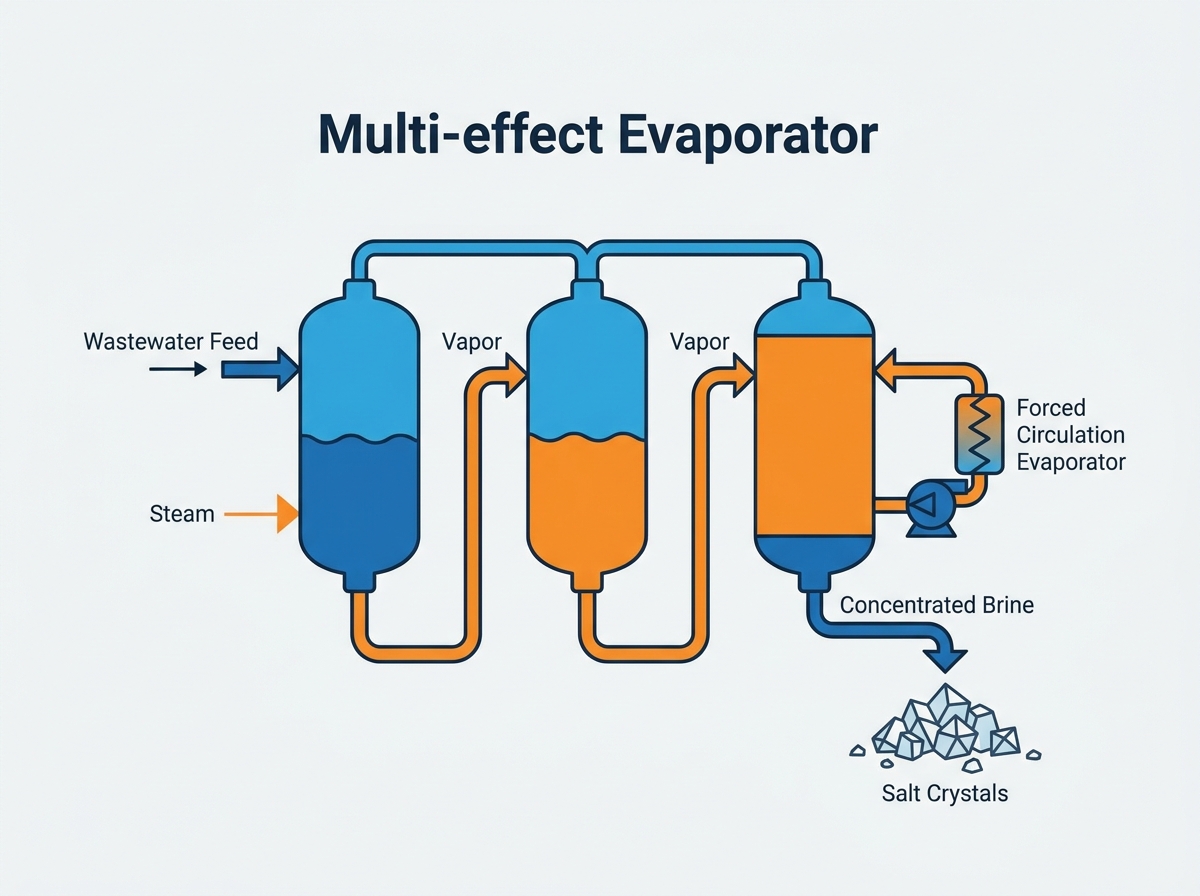
Reaching saturation is only the first phase of zero liquid discharge. Transforming concentrated brine into solid crystals requires specialized fluid dynamics. Standard equipment designs fail rapidly when pushed into the crystallization phase. You must transition to heavy-duty mechanical systems to handle the phase change from liquid to solid.
Falling film and natural circulation evaporators rely on gravity and thermal density differences to move liquid. These mechanisms work perfectly for dilute solutions. However, they fail catastrophically when handling slurries or highly viscous, near-saturation solutions. As the liquid film travels down a heated tube, localized evaporation causes dry spots. Salt crystals immediately form on these dry patches. The nucleation process accelerates rapidly once the first crystals attach to the metal. The tubes plug completely within hours, halting production and requiring intense hydro-blasting to clear. You cannot use falling film technology once the fluid reaches the metastable zone.
A Forced Circulation Evaporator eliminates dry spots through brute mechanical force. The system utilizes high-volume axial flow pumps to push the heavy brine through the heat exchanger. These pumps maintain high tube velocities, typically ranging from 1.5 to 3.0 meters per second. This high velocity creates intense turbulence, keeping the boundary layer thin and preventing solids from settling. The sheer force of the fluid scours the tube walls continuously.
The design intentionally suppresses boiling inside the heat exchanger tubes. The pump maintains sufficient hydrostatic pressure to keep the liquid in a single phase while it absorbs heat. The superheated liquid only boils when it exits the tubes and enters the vapor-liquid separator, where the pressure drops. Flashing occurs in the open vessel, safely away from the heat transfer surfaces. This mechanism prevents scale formation on critical metal components. Operators must monitor the mechanical seals on these axial flow pumps constantly, as the abrasive salt slurry will destroy standard packing materials quickly. Double mechanical seals with clean flush water are mandatory.
Producing high-purity salt requires precise control over crystallization kinetics. You must manage the supersaturation profile to yield large, filterable crystals. Rapid flashing creates excessive nucleation, resulting in fine, dust-like crystals that blind centrifuge screens and retain high moisture content. A well-designed crystallizer body provides adequate residence time.
The vessel allows the supersaturated liquid to contact existing salt crystals suspended in the slurry. The dissolved salts precipitate onto these existing structures rather than forming new nuclei. This promotes steady crystal growth and ensures the final product separates cleanly from the mother liquor. Draft tube baffle designs or Oslo-type crystallizers are frequently employed to classify the crystal sizes, allowing only the largest, fully formed crystals to exit the system for dewatering.
Industrial brine treatment demands a hybrid approach. No single evaporator type efficiently handles both dilute wastewater and dense crystal slurries. You must combine technologies to optimize energy consumption and mechanical reliability. Integrating these systems requires precise mass and energy balancing.
The standard industrial configuration utilizes falling film effects for the initial pre-concentration phase. Falling film units offer excellent heat transfer coefficients at low viscosities and require minimal pumping power. They efficiently remove the bulk of the water from the dilute brine. Once the concentration approaches the saturation point and viscosity spikes, the system transitions the fluid to a Forced Circulation Evaporator. This unit handles the final, high-density crystallization stage, absorbing the heavy mechanical load required to manage the slurry. This hybrid setup minimizes the electrical load by restricting the massive axial flow pumps only to the final stage where they are absolutely necessary.
Complex brines rarely contain a single salt. They often consist of sodium chloride mixed with calcium or magnesium chlorides. You must sequence the thermal equipment to selectively precipitate and recover different salts. Dumping a mixed salt cake into a landfill defeats the purpose of advanced recovery.
Engineers utilize a two-step evaporation method to separate these compounds. Sodium chloride crystallizes at a lower concentration threshold. The system first precipitates the sodium chloride, routing the slurry to a pusher centrifuge for extraction. The remaining mother liquor, now rich in magnesium chloride, flows into a secondary high-temperature crystallization loop. This fractional approach allows facilities to recover multiple distinct, high-purity industrial salts from a single mixed waste stream. You must control the temperature and concentration setpoints precisely to prevent co-precipitation, which ruins the purity of both salt products.
Combining different evaporator types requires meticulous thermal integration. You must route the vapor generated from the pre-concentration effects into the heating bundle of the forced circulation stage. This cascading vapor flow maximizes the steam economy, defined as the kilograms of water evaporated per kilogram of live steam consumed.
Designers must analyze the trade-offs between thermal efficiency and mechanical load. Pushing vapor through multiple effects reduces steam consumption but lowers the available temperature difference for the final crystallizer. This requires larger heat exchangers and more powerful axial flow pumps to maintain velocity. Balancing the steam economy against the electrical load required by the forced circulation pumps remains the most critical engineering task during system integration. You must ensure the vapor ducting is sized correctly to prevent pressure drops that would further erode the available temperature difference.
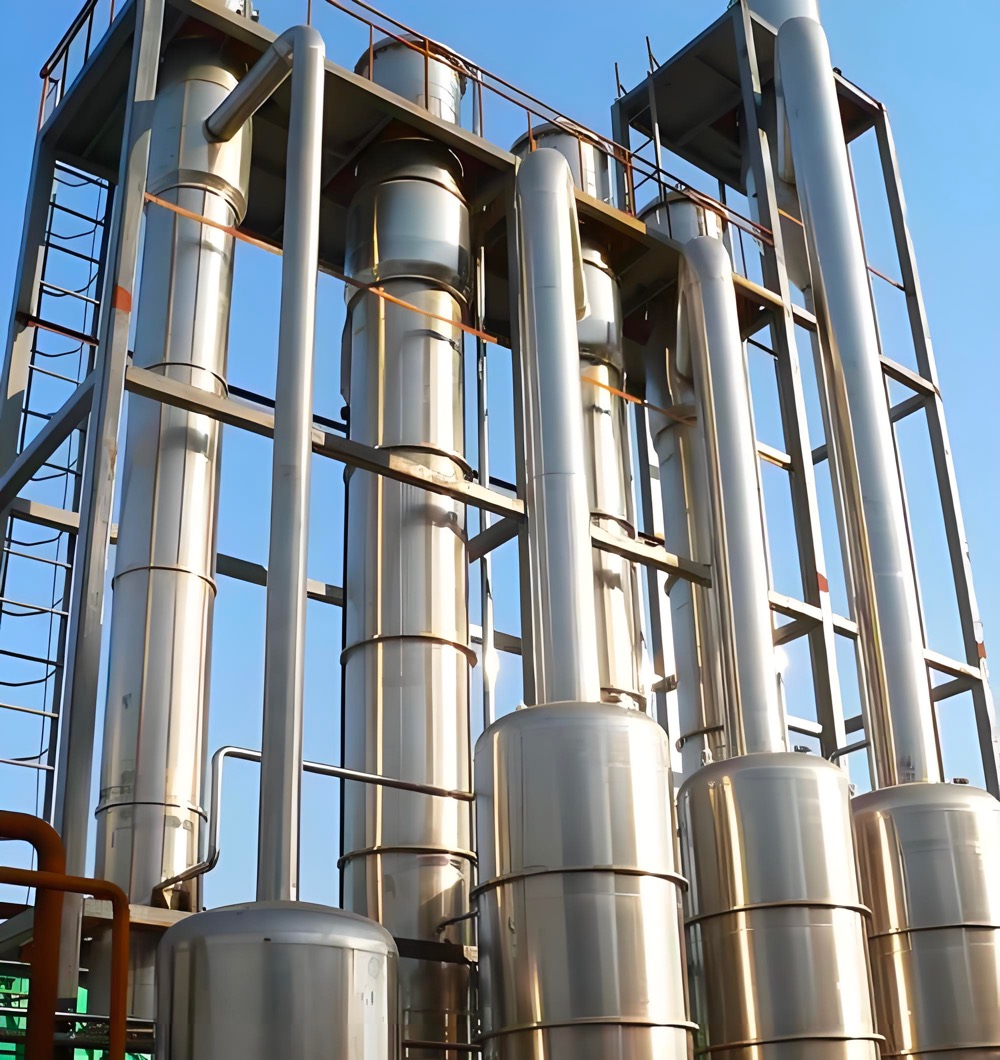
Hot, concentrated chloride brines destroy standard metals. Selecting the wrong metallurgy guarantees rapid equipment failure, catastrophic leaks, and massive replacement downtime. Material selection dictates the operational lifespan of the entire treatment facility. You cannot cut corners on the alloys used in the wetted parts.
Standard austenitic stainless steels, such as 304L and 316L, cannot withstand high-salt environments. When exposed to hot chlorides and tensile stress, these alloys suffer from Chloride Stress Corrosion Cracking. Microscopic cracks propagate rapidly through the metal grain boundaries. The equipment can look perfectly intact from the outside while structural integrity completely fails internally. You must eliminate standard stainless steels from any high-temperature chloride application. Even brief exposure during a process upset can initiate cracking that will eventually lead to a catastrophic vessel failure.
Engineers use a strict decision framework for selecting materials based on chloride concentration, operating temperature, and fluid pH. The Pitting Resistance Equivalent Number guides these choices. Higher numbers indicate greater resistance to localized pitting and crevice corrosion.
Material Grade | Application Environment | Corrosion Resistance Characteristics |
|---|---|---|
Super Duplex (SAF 2507) | Moderate temperatures, high chlorides | Excellent resistance to CSCC; highly durable for pre-concentration stages. |
Titanium (Grade 2) | High temperatures, near-saturation brines | Immune to pitting in oxidizing chloride environments; standard for crystallizers. |
Titanium (Grade 7) | High temperatures, acidic/reducing brines | Palladium addition prevents crevice corrosion in low pH applications. |
High-Nickel Alloys (Hastelloy C-276) | Extreme pH variations, mixed aggressive acids | Ultimate resistance to localized corrosion; used when heavy trace metals exist. |
Titanium remains the industry standard for the wetted parts of a magnesium chloride crystallizer. While Super Duplex handles the lower-temperature pre-concentration effects, the extreme boiling point elevation in the final stages demands Titanium or high-nickel alloys to ensure a functional lifespan. Welding Titanium requires strict argon shielding to prevent oxygen embrittlement. You must ensure your fabrication shop holds the correct certifications for handling reactive metals, as poor welding will create immediate corrosion sites regardless of the base material quality.
Deploying a massive thermal separation plant carries inherent engineering risks. Brine chemistry rarely remains static. You must anticipate fluctuations and design the system to handle variations without shutting down. Managing the solid output is just as critical as managing the liquid input.
The primary risk involves unpredictable brine composition fluctuations. Upstream production changes often cause sudden spikes in organic loading or scaling ions. These spikes disrupt the metastable zone in the crystallizer, leading to off-spec, unfilterable salt dust. If the centrifuge cannot separate the solids, the entire plant backs up.
You mitigate this risk through mandatory comprehensive laboratory brine characterization. Never base a system design on a single water sample. Conduct longitudinal sampling to capture process variations over weeks or months. Furthermore, demand pilot-scale testing from your vendor prior to full-scale system design. Pilot testing validates the fractional crystallization steps and confirms the true boiling point elevation under dynamic conditions. Running a pilot skid reveals foaming tendencies and scaling rates that theoretical calculations often miss.
Zero liquid discharge generates massive volumes of solid salt. Treating this salt as a waste product creates a permanent logistical burden. Landfilling mixed-salt solid waste carries escalating regulatory restrictions and disposal fees. You must plan for the physical removal of tons of salt daily.
Evaluate the economic viability of recovering industrial-grade salts. By utilizing precise fractional crystallization, you can achieve greater than 99.7% purity for sodium chloride, calcium chloride, or magnesium chloride. These high-purity byproducts hold significant resale value in de-icing, dust control, and chemical manufacturing markets. Transforming a toxic waste liability into a monetized byproduct fundamentally changes the operational strategy of the facility. You must select the correct dewatering equipment, such as peeler centrifuges and fluid bed dryers, to hit the moisture specifications required by chemical buyers.
Initiate comprehensive water profiling over a 30-day period to capture all upstream process fluctuations and trace scaling agents.
Request dynamic pilot testing from vendors to physically validate the fractional crystallization steps and confirm actual boiling point elevation data.
Evaluate your local industrial salt market to determine the exact purity specifications required to monetize recovered calcium and magnesium chlorides.
Audit your existing pre-treatment infrastructure to ensure it can adequately remove silica and organics before feeding the thermal system.
VNOR develops and manufactures evaporation and crystallization systems, including MVR, multi-effect, and heat-pump evaporators for wastewater, pharmaceutical, and chemical applications. Its services cover system design, fabrication, installation, commissioning, and after-sales support, helping customers configure solutions around feed chemistry, capacity, and resource-recovery goals.
A: While these systems handle extremely high Total Dissolved Solids, the limit depends on the saturation point and boiling point elevation of the specific salts. Typically, they pre-concentrate brines up to 20-30% TDS before handing the fluid off to a crystallizer. Specialized designs can accept feed streams already at 98% saturation.
A: Magnesium chloride becomes highly viscous and prone to severe scaling at high concentrations. Forced circulation uses powerful pumps to maintain high fluid velocity. This suppresses boiling inside the heat exchanger tubes, forcing the liquid to flash only in the separator, which prevents catastrophic tube fouling.
A: High concentrations of calcium and magnesium raise the boiling point of the brine significantly above pure water. This reduces the available temperature difference between the heating steam and the boiling liquid. Engineers must calculate this loss precisely to ensure subsequent effects have enough thermal driving force to operate.
A: You must condition the raw brine to prevent premature fouling. Essential steps include pH adjustment, silica removal to prevent glass-like scaling, and organics removal to stop severe foaming. Targeted sulfate removal is also necessary to ensure the final crystallized salts meet purity standards.
A: Engineers use fractional crystallization and two-step evaporation. Because different salts reach saturation at different concentrations and temperatures, the system precipitates them sequentially. Sodium chloride is crystallized and removed first, leaving a magnesium chloride-rich melt for the secondary crystallization stage.
A: Standard stainless steels like 304L and 316L fail rapidly in hot chloride environments. To prevent cracking, you must specify high-grade metallurgy based on the temperature and pH. Super Duplex stainless steel, Titanium Grade 2 or 7, and high-nickel alloys like Hastelloy are required for long-term durability.

