
Views: 0 Author: Site Editor Publish Time: 2025-08-25 Origin: Site


Multi-effect evaporators save energy by using heat again. They do this in many steps. This can cut steam use by up to 90%.
New technologies like AI and machine learning help a lot. Vapor recompression also helps control MEEs better. These tools make MEEs work well and cost less.
Changing the design can help too. Backward-feed setups use less energy. Better materials make the system last longer.
Using renewable energy like solar thermal is good. Waste heat can also be used. This lowers fuel use and greenhouse gases.
Doing regular maintenance is important. Cleaning helps MEEs work well. Smart control of scaling and corrosion keeps them running. This makes MEEs last longer.
Multi-effect evaporator systems help save energy in many industries. Companies use a lot of energy because vaporization needs lots of heat. Even with better designs, this is still hard to fix. Mineral-rich solutions can cause scaling and fouling. This makes heat transfer less effective and means more cleaning is needed. Skilled workers must run these systems. This makes costs go up and uses more energy.
Many things make companies choose energy-efficient multi-effect evaporators:
Small and medium businesses may not afford the high starting cost.
Complex designs and skilled workers make running costs higher. Fouling and scaling mean more repairs and cleaning.
Multi-effect evaporators can save up to 90% energy. They reuse heat, so less steam is needed and less carbon is made.
Companies want to save water and reach zero liquid discharge. This is very important for places that use lots of water.
New technology like heat recovery and digital tools help save money and protect the environment.
Multi-effect evaporators help companies reuse water and meet green goals. Energy-saving designs can cut energy use by up to 25%. This helps companies spend less on running costs. But putting in and fixing these systems needs experts. This can make starting and keeping them working cost more. Companies must find ways to save energy, spend less, and help the planet to stay ahead.
New rules keep changing how energy is saved in multi-effect evaporator systems. In the United States, new HVAC rules and SEER2 ratings set higher standards. Makers now use better technology to meet these rules. This changes how equipment is made and put in.
The U.S. Department of Energy wants stricter rules for commercial refrigeration. This includes evaporators. New rules need better insulation, special motors, and electronic controls. Evaporator fan control is not allowed now because of food safety worries. These changes affect how much equipment costs and how much energy can be saved.
Federal programs like the Clean Energy Standard give rewards for using energy-saving evaporators. Companies must update their buildings and use new ideas to follow these rules. These actions help with green goals and what customers want. Knowing about new rules helps makers use less energy, spend less, and look better to the public.
Note: Following rules is very important for companies that want to save energy and help the planet with multi-effect evaporators. Learning about new rules helps keep products good and companies strong in the market.
Multi-effect evaporation uses several evaporators to save energy. The vapor from one stage heats the next stage. This process happens again and again. It helps use less steam and waste less heat. Each stage works at a lower pressure and temperature. This helps move energy better.
Steam heats the first effect and boils the solution.
The vapor from the first effect heats the second effect.
This keeps going for all effects and reuses energy.
The last vapor is condensed and can be used again. This cuts down on waste and saves energy.
There are different ways to set up MEEs. Forward feed moves the feed and condensate together. Backward feed moves the concentrate in the opposite way. This can help lower heating costs. Parallel feed sends the feed to each stage by itself. Many industries use these setups to save energy. Falling film evaporators also help MEEs work better.
Tip: Clean heat transfer surfaces often. Use strong vacuum systems. These steps help MEEs work better.
Many things affect how much energy MEEs use. The temperature of the heating steam is very important. It decides how many effects there are. It also sets the heat transfer temperature difference. A higher vacuum lowers the boiling point. This means less energy is needed. It also protects products that are sensitive to heat. The temperature difference between effects must be right. If not, energy can be lost.
Feed volume, concentration, and temperature matter too. They change how well heat moves and how much can be evaporated. Ejectors and pumps also help. Good seals and the right flow rates keep things balanced. They stop heat from escaping. Altitude can change how the vacuum system works. It can also change heat transfer because air pressure is different.
More effects mean better steam economy. Adding more effects uses less steam. This makes MEEs more energy efficient. The table below shows how much steam is used for different numbers of effects:
Number of Effects | Steam Consumption (kg steam per 100 kg water evaporated) |
|---|---|
Single Effect | 110 |
Double Effect | 55 |
Triple Effect | 33 |
Four Effects | 28 |
Five Effects | 22 |
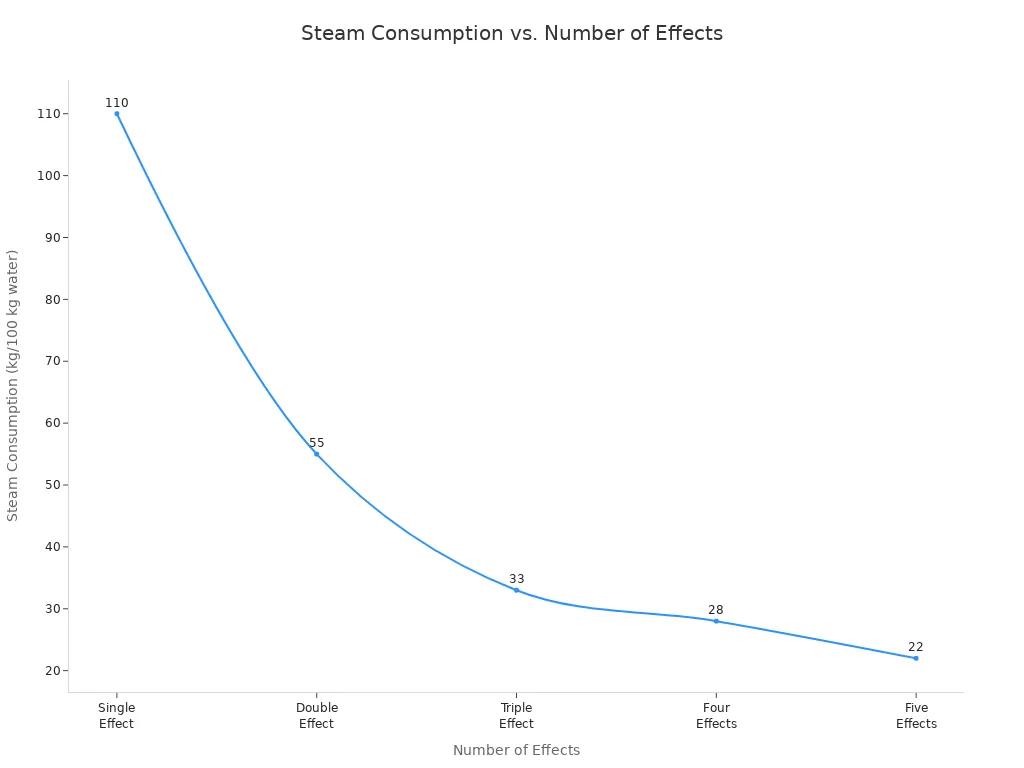
MEEs can use less steam for each unit of water evaporated. This means they use less energy and cost less to run. Keeping up with maintenance and checking how things work helps keep efficiency high. It also helps make sure the product stays good. MEEs work well for salty and high-boiling-point materials. This makes them a good choice for many industries.
Heat recovery strategies are very important for saving energy in multi-effect evaporation systems. When operators capture and reuse heat, they use less energy. This helps lower costs and makes the system work better. These strategies help industries like dairy, chemical, and pharmaceuticals. They help companies reach green goals and follow strict rules.
Vapor recompression is a top way to save energy in multi-effect evaporators. This method uses a compressor to make vapor hotter and under more pressure. The new vapor then heats the next stage. This means less new steam is needed.
Aspect | Explanation | Impact on Energy Efficiency |
|---|---|---|
Vapor Compression Method | Mechanical Vapor Recompression (MVR) uses a centrifugal compressor to compress secondary vapor. | Enables reuse of vapor as a heat source, reducing steam consumption. |
Energy Source Substitution | MVR replaces part of the steam demand with electricity for vapor compression. | Reduces overall steam demand and energy costs. |
Comparison with Conventional Systems | MVR-assisted multi-effect evaporation uses less steam than conventional systems and less electricity than single-effect MVR. | Demonstrates superior energy efficiency among evaporation technologies. |
Latent Heat Recovery | MVR recovers latent heat from secondary vapor more effectively. | Maximizes heat reuse and boosts overall efficiency. |
Application Example | In the pulp and paper industry, MVR-assisted multi-effect evaporation reduces steam use and annualized costs by up to 77.54%. | Validates practical energy and cost savings in industrial use. |
Many companies use vapor recompression to save energy. For example, a dairy plant used 50% less steam and made thicker products. A chemical company saved 45% on energy after adding a four-effect evaporator with vapor recompression. These real examples show vapor recompression can save a lot of energy and make work better.
Tip: Operators should check compressors often and keep seals tight. This helps vapor recompression work well and saves energy.
Cascading heat exchange is key in multi-effect evaporation. This strategy uses heat from one stage to power the next. This lets many stages run with the same energy. It cuts energy use and helps make more product that is also purer.
Aspect | Benefits | Limitations |
|---|---|---|
Energy Efficiency | Heat from one effect is reused in the next, enabling more distillate with the same energy input. | Higher capital cost compared to single-effect evaporators. |
Scalability | Easy to increase number of effects to double or triple production without extra energy use. | Requires sufficient pressure and temperature gradients; complexity increases with more stages. |
Waste Management | Minimizes waste volume and reduces waste management costs; supports zero discharge systems. | Complexity in operation and maintenance due to vacuum and pressure control. |
Environmental Impact | Reduces greenhouse gas emissions and water consumption by reusing treated water. | May not suit all product types, especially those sensitive to temperature or treatment. |
Cascading heat exchange works well in many industries. In milk powder plants, falling film evaporators make milk solids go from 12% to 52%. This uses heat sharing and vapor recompression to save energy and money. In medicine making, better multi-effect evaporation systems cut fuel costs by 40% and used less water.
Operators can get the most heat recovery by doing these things:
Put insulation on evaporator surfaces to stop heat loss.
Use smart control systems to watch temperature and change settings fast.
Pre-heat the feed with waste heat from the process.
Keep temperature-controlled covers to protect from outside heat changes.
Note: Clean and maintain the system often. This stops fouling, which can block heat transfer and lower efficiency in multi-effect evaporation systems.
By using these strategies, companies can save energy and help the planet. Multi-effect evaporation with good heat recovery is still a top way to save energy and work better.
AI and machine learning have changed how people run multi-effect evaporation. These tools help workers watch and control mee systems right away. They check things like temperature, pressure, and concentration all the time. Workers use this information to make fast changes and keep the system working well.
Machine learning can find patterns in how mee systems act. In some factories, image processing and machine learning sort patterns and change settings by themselves. This helps stop mistakes and makes things work better. Workers can also use predictive Q-learning, which is a kind of reinforcement learning, to control the outlet concentration. This uses neural networks to guess what will happen if they change the steam flow. It helps keep the product good and lets workers react fast to changes.
AI and machine learning also help with predictive maintenance. They warn workers before problems start, so teams can fix things early. This means less downtime and keeps mee systems working smoothly. Workers can use digital twins, which are computer copies of real systems, to test changes before trying them for real. This helps with research and finding the best ways to save energy.
Tip: Workers should learn to use AI tools and understand the data. This helps everyone work together to make mee systems better.
Advanced control and monitoring systems are very important in multi-effect evaporation. These systems let workers change temperature, pressure, and flow rates right away. Model Predictive Control (MPC) is one example. MPC helps workers use less energy by 5-10% and make more product by up to 10%. It also keeps the product more even and lowers the chance of fouling.
Workers use advanced control and monitoring systems to look for fouling and plan cleaning at the best time. In dairy plants, this has cut energy use by 12% and saved money every year. When cleaning matches what the system needs, energy costs can drop by 15% without hurting safety or quality.
Here are some ways to make multi-effect evaporation work better:
Pick the best number of effects for saving energy and money.
Keep temperature, pressure, and flow rates at good levels.
Use advanced control and monitoring systems for quick changes.
Clean heat transfer surfaces often to stop fouling and rust.
Train workers to run and take care of mee systems well.
Connect mee with other separation processes, like membrane distillation.
Use new materials, like graphene, to help heat move better and last longer.
Mix design, operation, and maintenance for the best results.
Technique | Benefit |
|---|---|
Model Predictive Control (MPC) | Uses less energy and makes more product |
Predictive Maintenance | Cuts downtime and repair costs |
Digital Twins | Tests changes before using them for real |
Real-Time Monitoring | Keeps system safe and working well |
Workers who use advanced control and monitoring systems get better energy use, lower costs, and more reliable mee systems. Studies show that using nonlinear energy modeling with smart optimization can boost efficiency by over 77% and cut steam use by almost 27%. These gains come from watching boiling point elevation, fouling, and using waste steam as heat.
Note: Training and regular care help workers get the most from advanced control and monitoring systems. This helps keep multi-effect evaporation working its best.
Backward-feed design is a big new idea for multi-effect evaporators. In this setup, the thickest solution goes into the last effect. This last effect has the lowest pressure and temperature. The feed then moves backward through each effect. It meets hotter steam as it goes. This setup helps the system use heat better.
Studies say backward-feed design can make steam economy over 50% better. Steam use drops by almost 30% compared to old designs. Operators get better heat transfer and more ways to run the system. Many pulp and paper mills use backward-feed design to save energy. It also helps them work better. When used with steam-split and feed-preheating, the system gets even more efficient. This design lets companies make more with less energy. It is a smart pick for modern multi-effect systems.
Note: Backward-feed design works best with advanced control systems. Operators can change settings fast to match feed or product changes.
Picking the right material is very important for multi-effect evaporators. New materials help stop corrosion and make heat move better. They also help the equipment last longer. Stainless steel, copper, and titanium are often used. Each one has its own balance of cost, heat movement, and corrosion resistance.
Material | Corrosion Resistance | Thermal Conductivity | Cost |
|---|---|---|---|
Stainless Steel | High | Medium | Medium |
Copper | Medium | High | High |
Titanium | High | Medium | High |
Engineers now use stainless steel/carbon steel clad plates. These plates are strong and fight corrosion. They also cost less but still work well. Cladding uses explosion bonding or rolling bonding to make tough layers. Stainless steel has chromium, nickel, and molybdenum. These make a film that protects against corrosion and damage.
New materials like graphene and nanomaterials are being used too. These help heat move even better and make the system last longer. Using better materials keeps multi-effect evaporators working well for more years. This means lower repair costs and better product quality.
Tip: Check and clean the system often. This keeps the good effects of advanced materials in multi-effect systems.
Solar thermal energy is a top renewable source for multi-effect evaporators. Many factories now use concentrating solar thermal (CST) technology. Parabolic Trough Collectors (PTC) and Linear Fresnel Reflectors (LFR) are common CST types. LFR systems have some good points. They are lighter and need less land. Their receiver does not move, so cleaning is easier. They also have lower pumping losses.
These systems heat a fluid to about 120°C. The hot fluid gives energy to the evaporator. This lets the evaporator use renewable heat instead of fossil fuels. It helps cut down on emissions. Sometimes, molten salts store heat for use after dark. Hybrid systems can mix solar with other energy sources. This helps the evaporator work all day and night.
Industries like wastewater treatment and food processing use this renewable energy. In pulp and paper factories, solar thermal fields cut normal heat use by up to 93%. Other ways to save energy include feed preheating and vapor compression. These steps make the system even more efficient. Solar-powered evaporators help companies spend less and reach green goals.
Note: Using solar thermal energy with multi-effect evaporators helps companies save energy and lower greenhouse gas emissions. This supports both money and environmental goals.
Factories make waste heat during production. This waste heat is another good energy source for multi-effect evaporators. By using this heat again, companies use less fuel and save energy.
Some best ways to use waste heat are listed below:
Design evaporators to move heat quickly and well.
Pick materials that do not rust or get dirty easily.
Run at lower pressures for products that are sensitive to heat.
Use vapor recompression or heat pumps to make low-temperature waste heat more useful.
Each plant should study its own needs to find the best way to use waste heat. Heat exchangers must fit the plant and handle changes in temperature or flow. If done right, using waste heat lowers costs and makes the system more reliable.
Tip: Keep up with maintenance and choose the right materials. This helps heat exchangers work well and last longer.
Scaling and corrosion are big problems for multi-effect evaporators. Operators can stop these problems by using smart steps:
Test water to find out which scaling ions are there.
Use filters and softeners to take out hard ions and dirt.
Add anti-scalants and corrosion inhibitors to protect metal parts.
Pick strong materials like stainless steel or titanium for important parts.
Watch temperature, pressure, and flow to spot fouling early.
Clean the system often with chemicals or tools to remove buildup.
Automated chemical dosing systems help by adding the right amount of chemicals. This cuts down on waste and makes things work better. Cleaning-in-place (CIP) systems clean out scale fast without taking apart the equipment. This keeps everything working well.
Tip: Check the system often and clean it quickly. This keeps efficiency high and helps equipment last longer.
Feed composition can change a lot in factories. These changes can hurt how well the system works and the quality of products. Operators use smart controls to handle different feeds:
Use feedback and model predictive control to change settings right away.
Change feed flow and heat areas to match different loads.
Try simulation and optimization tools to pick the best setup.
Use feed-split and feed-preheating to deal with changing feeds.
Here is a table that shows good strategies:
Strategy | Benefit |
|---|---|
Advanced control | Keeps the system running smoothly |
Feed optimization | Handles bigger loads and more types of feeds |
Hybrid energy-saving | Uses less steam and saves money |
Operators who follow these steps keep the system working well and make good products, even when feeds change.
Regular care helps multi-effect evaporators work well and last longer. Plant teams should do these things:
Clean heat transfer surfaces every month to stop fouling and rust.
Look for leaks, cracks, or bad gaskets and fix them fast.
Keep flow rates and pressure at the right levels.
Test how the system works by checking temperatures and heat transfer.
Upgrade parts like valves or coils to make things better.
Skilled technicians are important for checking, cleaning, and setting controls. Training programs teach operators new skills and ways to fix problems.
Note: Good training and regular care help teams get the best results and keep multi-effect evaporators working well.
Industry leaders save the most energy by reusing vapor. They also make process pressure better and use advanced heat exchangers in every multi-effect evaporator. Many factories now use AI, digital twins, and automated controls. These tools help mee systems work their best. Teams add solar and waste heat to mee systems. This lowers costs and cuts down on emissions. Regular upgrades and good habits help mee systems last longer. They also help the systems work better. Companies that spend money on these changes make mee systems stronger, greener, and ready for the future.
Multi-effect evaporators help companies use less energy. They move heat from one stage to another. This means they need less steam. It also helps companies spend less money to run the system.
AI systems watch temperature, pressure, and flow all the time. They let workers change settings fast. This keeps the system working well and saves energy.
Yes, solar thermal and waste heat can run these systems. Many factories use solar panels or take heat from other machines. This helps use less fuel and makes less pollution.
Scaling happens when minerals stick to hot surfaces. Operators can use water softeners and anti-scalants. Cleaning often also helps keep the system working well.
Teams should check and clean heat transfer surfaces every month. Regular checks help find leaks or dirt early. Good care keeps the system running smoothly.

