
Views: 0 Author: Site Editor Publish Time: 2026-10-13 Origin: Site


Managing high-COD and high-TDS industrial effluent presents severe operational challenges across chemical manufacturing, pharmaceuticals, and food processing. Conventional wastewater treatment approaches frequently fall short. Biological processes fail rapidly under toxic shock loads or extreme COD concentrations. Traditional thermal evaporation relies on volatile steam energy and struggles to maintain efficiency when processing complex, highly concentrated salt solutions. Mechanical Vapor Recompression (MVR) provides a reliable thermal separation technology for achieving Zero Liquid Discharge (ZLD) and drastic effluent volume reduction. Specifying the correct MVR Evaporator for Wastewater requires a rigorous evaluation of fluid chemistry, energy dynamics, and operational reliability. We will examine the specific engineering parameters necessary to design, select, and implement a highly effective evaporation system tailored for complex industrial streams.
Energy Economics: MVR systems typically reduce energy consumption by 60–75% compared to traditional Multi-Effect Evaporators (MEE) by acting as an advanced heat pump system that recycles latent heat via mechanical compression.
Design Dictated by Chemistry: High-COD wastewater necessitates specific heat exchanger designs (e.g., forced circulation over falling film) and precise temperature control to mitigate severe fouling, scaling, and boiling point elevation.
Material Selection is Critical: The presence of chlorides and corrosive organics in high-COD streams requires precise metallurgy (e.g., Titanium, Duplex stainless steel) to prevent catastrophic equipment failure.
Mandatory Pilot Testing: Theoretical modeling is insufficient; bench-scale or pilot testing (e.g., 5.0–16.0 kg/h evaporation rate) is required to validate performance metrics and establish baseline maintenance cycles before full-scale CapEx.
Table of Contents
MVR evaporators treat high-COD wastewater by recycling vapor heat, reducing external steam consumption and improving energy efficiency. The system compresses secondary vapor to increase its temperature, allowing it to serve as the heating source for continued evaporation.
MVR technology uses a mechanical compressor to increase the pressure and temperature of generated vapor. The compressed vapor then condenses in the heat exchanger, transferring heat back to the wastewater and reducing the need for additional steam during steady-state operation.
Vacuum operation lowers the wastewater boiling temperature, helping reduce thermal degradation, scaling, and corrosion risks. Operating temperatures depend on wastewater composition and system design, making vacuum control important for stable evaporation.

High organic concentrations can affect evaporation performance through several factors:
Boiling Point Elevation (BPE): Increases the temperature required for evaporation.
High Viscosity: Reduces heat transfer efficiency and increases circulation power.
Foaming: Causes liquid carryover and may damage compressor components.
Scaling and Fouling: Reduce heat exchanger performance and increase cleaning requirements.
Reliable MVR operation requires effective vapor separation, stable temperature control, and regular Clean-in-Place (CIP) maintenance. Proper system design helps maintain distillate quality, reduce compressor downtime, and support continuous wastewater concentration.
Heat exchanger selection depends on wastewater viscosity, COD, TDS, and scaling tendency. Falling film evaporators are suitable for low-viscosity liquids, while forced circulation systems are preferred for high-COD, high-TDS, and crystallizing wastewater. Plate heat exchangers offer compact designs but require careful consideration of fouling and maintenance.
Configuration | Best Application | Key Advantage |
|---|---|---|
Falling Film | Low-viscosity, low-TDS wastewater | High heat transfer efficiency |
Forced Circulation | High-COD, high-TDS, crystallizing wastewater | Reduced scaling and improved circulation |
Plate Heat Exchanger | Cleaner fluids and limited installation space | Compact structure and efficient heat transfer |
Compressor selection is critical to MVR evaporator efficiency. The required compression ratio depends on boiling point elevation (BPE), vapor flow, and heat transfer requirements. Roots blowers are suitable for certain higher-pressure-rise applications, while centrifugal compressors are commonly used for large vapor flow rates.
Compressor Type | Main Advantage | Suitable Application |
|---|---|---|
Roots Blower | Positive displacement and stable volumetric delivery | Small to medium systems requiring suitable pressure rise |
Centrifugal Compressor | High vapor flow capacity and energy efficiency | Large-scale evaporation systems |
Proper vapor separation and compressor protection help prevent liquid carryover and equipment damage.
Material selection should consider chloride concentration, pH, operating temperature, and wastewater corrosiveness. Choosing compatible materials helps prevent pitting, stress corrosion cracking, and premature equipment failure.
Material | Suitable Conditions | Key Consideration |
|---|---|---|
316L Stainless Steel | Mildly corrosive wastewater with limited chloride content | Economical but vulnerable to concentrated chlorides |
Duplex Stainless Steel | Moderate chloride exposure | Improved corrosion resistance |
Super Duplex Stainless Steel | More demanding chloride environments | Higher resistance to localized corrosion |
Titanium | Selected highly corrosive applications | Strong corrosion resistance but higher cost |
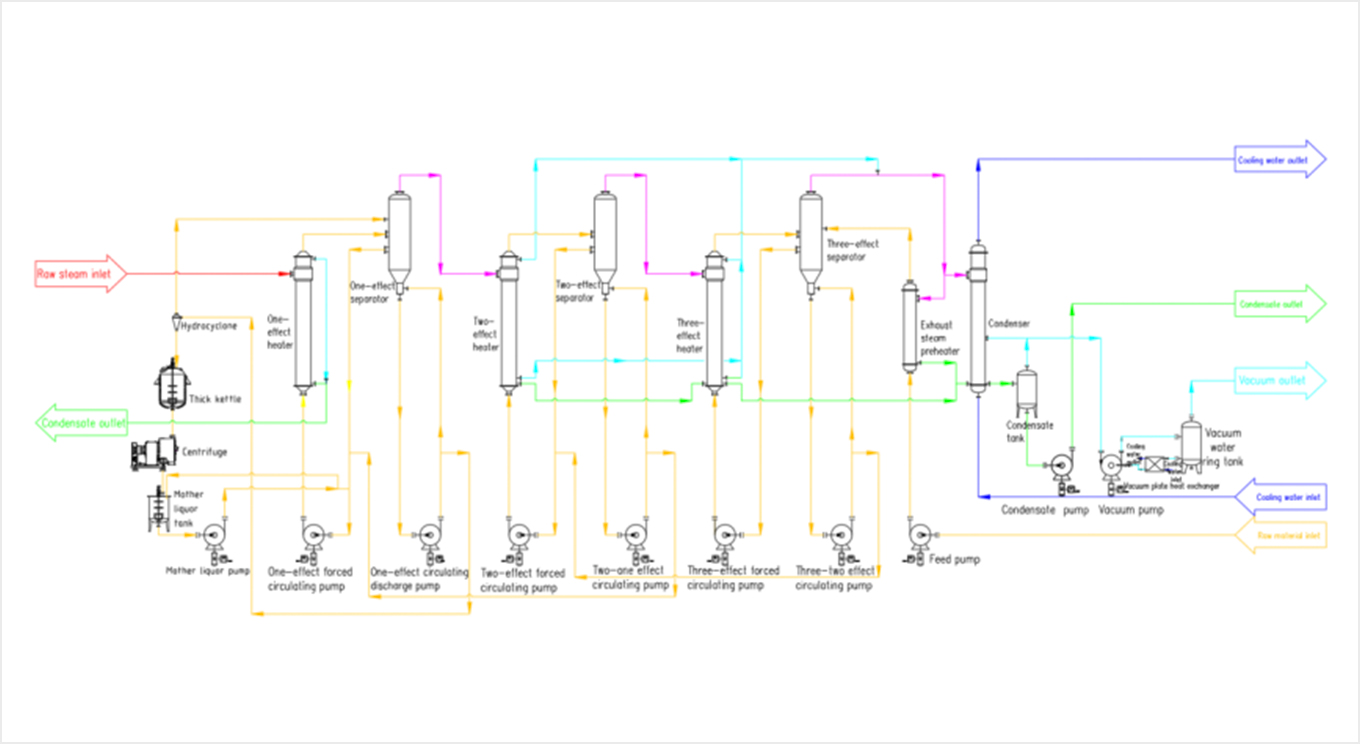
Mechanical Vapor Recompression (MVR) and Multi-Effect Evaporation (MEE) differ mainly in energy consumption, infrastructure requirements, and operating costs. MVR recycles vapor heat using an electrically driven compressor, while MEE reuses heat across multiple evaporation stages but typically requires an external steam supply.
Comparison Factor | MVR Evaporator | MEE Evaporator |
|---|---|---|
Energy Source | Primarily electricity | Primarily steam |
Energy Efficiency | High heat recovery efficiency | Multiple-effect heat reuse |
Installation Requirements | Compressor and electrical infrastructure | Steam supply and condensation system |
Operating Costs | Depends on electricity prices | Depends on steam and fuel costs |
Maintenance Focus | Compressor, heat exchangers, and scaling | Multiple effects, heat exchangers, and scaling |
Best Applications | Facilities with reliable electricity | Facilities with available low-cost steam |
Key Takeaway: MVR can reduce thermal energy demand and operating costs, particularly where electricity is economical. However, actual savings depend on wastewater characteristics, utility prices, and system design.
Proper MVR evaporator sizing requires evaluating wastewater composition, evaporation capacity, scaling behavior, and operating flexibility. Pilot testing helps verify performance before full-scale installation, especially for high-COD or complex industrial wastewater.
Analyze COD, TDS, pH, viscosity, and boiling point elevation (BPE) to determine wastewater behavior during concentration. These parameters influence heat transfer efficiency, compressor requirements, and equipment selection.
Pilot testing helps validate evaporation efficiency, concentrate behavior, and distillate quality under realistic operating conditions.
Test Item | Main Purpose |
|---|---|
Boiling Point Elevation | Determine temperature and compression requirements |
Scaling and Fouling | Evaluate heat exchanger performance |
Foaming Behavior | Identify vapor separation and defoaming needs |
Energy Consumption | Estimate actual operating costs |
Distillate Quality | Verify discharge or reuse suitability |
Industrial wastewater flow rates often change with production demand. MVR systems equipped with Variable Frequency Drives (VFDs) can adjust compressor and circulation pump operation within their designed operating range. Proper turndown capability helps maintain stable performance under varying loads.
MVR evaporators can serve as a key concentration stage in Zero Liquid Discharge (ZLD) systems. Effective integration includes:
Pre-treatment: Remove suspended solids, oils, and other fouling substances.
MVR Evaporation: Concentrate wastewater and recover condensate.
Crystallization: Further process concentrated brine to recover solids.
Solid-Liquid Separation: Separate crystals or sludge for subsequent handling.
Key Takeaway: Successful MVR system design depends on accurate wastewater analysis, representative pilot testing, flexible capacity control, and proper integration with upstream and downstream treatment equipment.
To move forward effectively with your wastewater volume reduction project, execute the following steps:
Initiate a comprehensive wastewater characterization to establish baseline metrics for COD, BOD, TDS, pH, and chloride concentrations.
Contact a specialized thermal separation engineering firm to conduct a preliminary feasibility study based on your specific volume requirements.
Commission a pilot test utilizing a representative sample of your wastewater to validate scaling rates, BPE, and energy consumption.
Define the upstream pre-treatment requirements necessary to protect the evaporator from suspended solids and free oils.
A: Energy consumption typically ranges from 15 to 35 kWh per ton of evaporated water. The exact electrical load depends heavily on the boiling point elevation of the wastewater, the required compression ratio, and the mechanical efficiency of the specific compressor utilized.
A: Yes. Handling both requires a forced circulation heat exchanger design. High-velocity fluid movement prevents localized boiling and manages the precipitation of solids and the high viscosity associated with complex organic and saline streams.
A: High BPE means the wastewater boils at a higher temperature than pure water. This requires a greater temperature increase across the blower to maintain heat transfer, dictating whether a single-stage, multi-stage, or high-pressure positive displacement compressor is necessary.
A: Operating under a vacuum allows the system to boil wastewater at lower temperatures, typically between 48°C and 80°C. This prevents the thermal degradation and polymerization of sensitive organics, reduces scaling potential, and minimizes thermal stress on the equipment.
A: A mist eliminator, or demister pad, sits in the vapor separator dome to capture entrained liquid droplets from the vapor stream. It prevents highly concentrated, corrosive brine droplets from entering the compressor, which would otherwise cause severe impeller erosion and mechanical failure.
A: Scaling is prevented by maintaining high fluid velocities through forced circulation, utilizing crystal seeding techniques to encourage precipitation in the bulk fluid rather than on tube walls, and implementing routine, automated Clean-in-Place (CIP) chemical wash cycles.

