
Views: 0 Author: Site Editor Publish Time: 2026-08-10 Origin: Site


Pharmaceutical manufacturing generates complex, highly regulated effluent streams. These include Clean-in-Place (CIP) washwater and compounding line rinses containing Active Pharmaceutical Ingredients (APIs), solvents, high salinity, and recalcitrant COD/BOD. Off-site disposal of this matrix is increasingly risky and heavily regulated. Traditional thermal separation methods demand massive energy inputs and risk thermal degradation of sensitive compounds. Conventional biological treatments fail against toxic or high-concentration pharmaceutical waste, as sudden pH shifts or solvent spikes destroy the biomass. Shifting from conventional disposal or high-temperature boiling to vacuum-assisted low-temperature evaporation alters the operational equation. This guide breaks down the technical evaluation, implementation risks, and operational realities of deploying a low-temperature heat-pump evaporator to achieve volume reduction, clean water recovery, or Zero Liquid Discharge (ZLD). We will examine the thermodynamics, material science, and field-tested strategies required to neutralize compliance risks while recovering valuable water resources on-site.
Table of Contents
OPEX Reduction: Heat-pump technology recovers latent heat, drastically reducing energy consumption per cubic meter of distillate compared to traditional boiler-fed evaporators.
API Integrity & Safety: Operating under a vacuum lowers the boiling point to 30–40°C, preventing the thermal degradation of volatile compounds and reducing corrosion rates.
Volume Minimization & Water Recovery: Capable of reducing wastewater volumes by up to 95%, transforming high disposal costs into manageable solid waste while recovering clean water for facility reuse.
Implementation Prerequisite: Success requires rigorous upfront effluent characterization to specify correct metallurgy (e.g., Titanium, Hastelloy) and pre-treatment protocols to manage foaming and scaling.
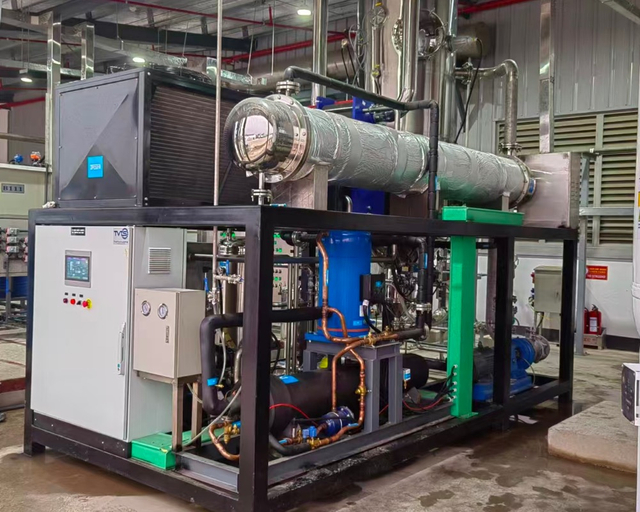
Wastewater generated from pharmaceutical and cosmetic compounding facilities presents a unique matrix of contaminants. Unlike standard industrial effluent, pharmaceutical washwater contains high concentrations of APIs, heavy metals, halogenated solvents, and elevated Total Dissolved Solids (TDS). CIP processes utilize aggressive surfactants, sodium hydroxide, and phosphoric acid to ensure equipment sterility. This results in wastewater with extreme pH fluctuations and severe foaming tendencies.
Regulatory agencies apply immense pressure on manufacturing facilities to eliminate API discharge into Publicly Owned Treatment Works (POTWs). Municipal treatment plants are not designed to process synthetic hormones, antibiotics, or endocrine disruptors. Discharging these compounds leads to severe compliance fines, immediate municipal discharge bans, and significant environmental public relations crises. Facilities must intercept and isolate these contaminants on-site before they reach the municipal sewer infrastructure. The concentration of these complex synthetic molecules requires separation technologies capable of handling aggressive chemical profiles without allowing volatile organics to escape into the environment.
Effluent Parameter | Typical Pharmaceutical Range | Impact on Separation Equipment |
|---|---|---|
Total Dissolved Solids (TDS) | 5,000 - 50,000+ mg/L | Drives boiling point elevation; increases viscosity and scaling risk. |
pH Levels | 2.0 - 12.0 (Highly variable) | Requires high-grade metallurgy to prevent rapid pitting and corrosion. |
Surfactants / Detergents | High concentration from CIP | Causes severe foaming under vacuum, risking distillate contamination. |
Active Pharmaceutical Ingredients | Trace to moderate mg/L | Requires low-temperature processing to prevent thermal degradation and VOC carryover. |
Chlorides | 1,000 - 10,000+ mg/L | Induces stress corrosion cracking in standard 300-series stainless steels. |
Conventional wastewater treatment methodologies consistently fail when applied to pharmaceutical effluent. Biological treatment systems rely on living microorganisms to consume organic matter. The high toxicity of APIs, combined with sudden spikes in solvent concentration or extreme pH shifts, easily destroys the biological mass. Bacteria cannot break down complex synthetic pharmaceutical molecules, allowing them to pass through the treatment system entirely unaffected.
Traditional high-temperature evaporators present a different set of severe drawbacks. Operating at atmospheric pressure requires boiling wastewater at 100°C or higher, demanding excessive energy costs primarily driven by fossil-fuel steam generation. At these elevated temperatures, scaling accelerates rapidly. Calcium, magnesium, and silica precipitate out of the solution, forming hard insulating layers on heat transfer surfaces that destroy system efficiency and require aggressive chemical cleaning. High-temperature boiling risks volatilizing toxic compounds and solvents, carrying them over into the distillate. This thermal degradation contaminates the recovered water and creates hazardous vapor emissions that violate air quality regulations.
The core physical principle driving modern pharmaceutical wastewater separation is the manipulation of vapor pressure. By utilizing a heavy-duty liquid ring or dry claw vacuum pump to depressurize the boiling chamber to approximately 30 to 40 millibars, the system artificially lowers the boiling point of water. Under this deep vacuum, water vaporizes rapidly at temperatures between 30°C and 40°C, rather than the standard 100°C required at atmospheric pressure.
This drastic reduction in boiling temperature provides a massive operational benefit for pharmaceutical applications. Lower temperatures ensure the safer handling of flammable or highly reactive pharmaceutical byproducts. Many complex organic compounds and solvents degrade, polymerize, or become highly volatile when exposed to high heat. By keeping the thermal energy low, the system preserves the integrity of these sensitive compounds. They remain trapped in the concentrated sludge rather than vaporizing and contaminating the clean distillate. This physical separation achieves the high distillate purity required for environmental compliance.
The thermal engine driving this process is a closed-loop thermodynamic cycle that completely eliminates the need for external steam boilers or cooling towers. A Low-temperature Heat-pump Evaporator utilizes a specialized refrigerant circuit to manage both the heating and cooling phases of the evaporation process simultaneously. The system operates solely on electrical power, recycling the latent heat of vaporization continuously.
Compression: The compressor pressurizes the refrigerant gas, raising its temperature significantly.
Heating (Evaporation): This hot gas passes through a heat exchanger submerged in the wastewater. It transfers its thermal energy to boil the effluent under vacuum. As it loses heat, the refrigerant condenses into a high-pressure liquid.
Expansion: The liquid refrigerant passes through an expansion valve. This drops its pressure and temperature drastically, creating a super-cooled fluid.
Cooling (Condensation): The cold refrigerant flows through a second heat exchanger located in the vapor zone of the chamber. It absorbs heat from the rising water vapor, causing the vapor to condense into clean liquid distillate. The refrigerant turns back into a gas and returns to the compressor.
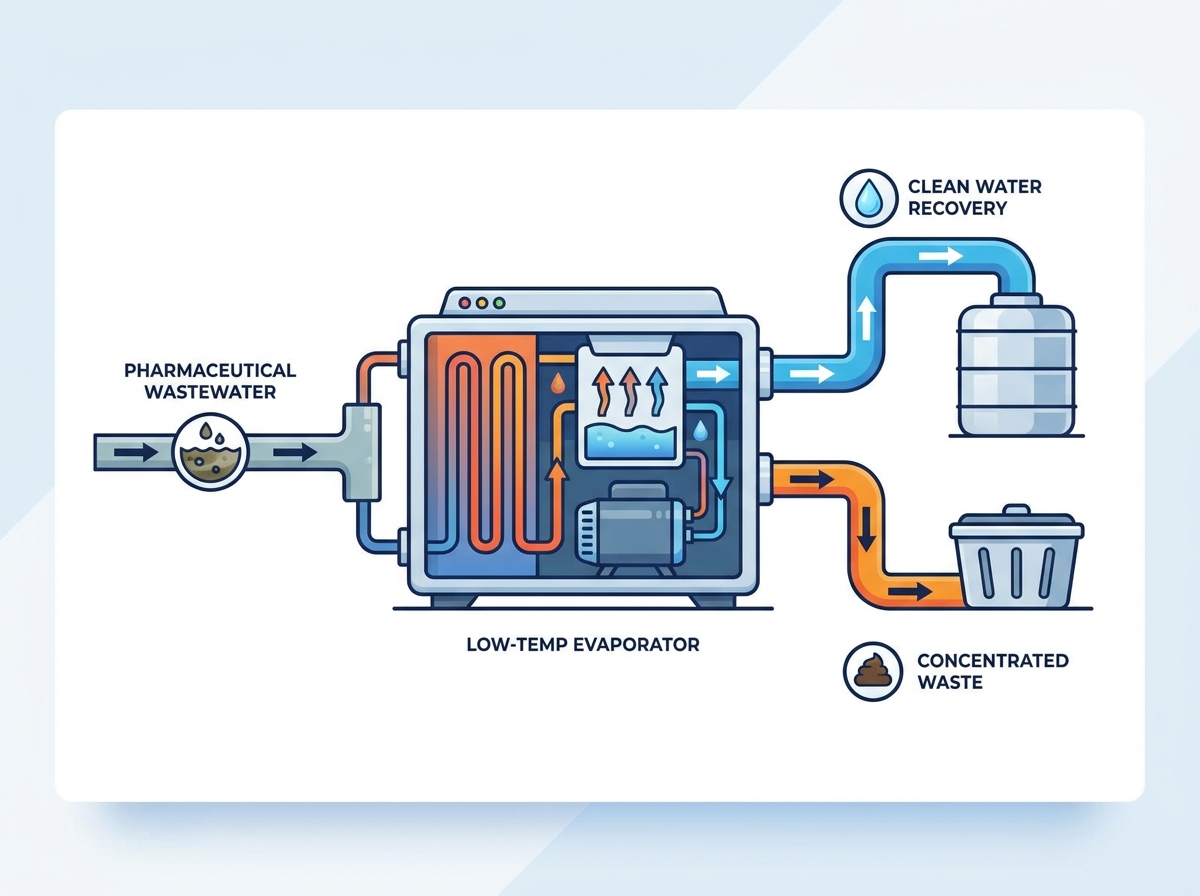
Energy efficiency is the primary metric when evaluating evaporation technologies. A well-designed vacuum heat-pump system establishes a highly efficient baseline, typically targeting an energy consumption rate of 120 to 250 kWh per ton of distillate produced. This variance depends heavily on the specific capacity of the unit, the initial concentration of the effluent, and the final density required for the concentrated waste.
When comparing the electrical operational expenditure of this technology against traditional methods, the advantages become clear for low-to-medium capacity applications. Mechanical Vapor Recompression (MVR) systems or Multiple-Effect Evaporators (MEE) often require supplementary steam, massive footprint allocations, and external cooling water infrastructure. The combined fuel and cooling costs of MEE systems, or the high maintenance demands of high-speed MVR blowers, often exceed the steady, predictable electrical draw of a closed-loop heat pump. Relying entirely on a standard electrical supply allows facilities to accurately forecast utility expenditures and insulate themselves from volatile fossil fuel markets.
Evaporation Technology | Primary Energy Source | Estimated Energy per Ton of Distillate | Best Fit Application |
|---|---|---|---|
Atmospheric Boiler | Natural Gas / Steam | 700 - 900 kWh equivalent | Obsolete for most modern industrial wastewater applications. |
Multiple-Effect (MEE) | Steam + Cooling Water | 250 - 400 kWh equivalent | High-volume continuous flows where cheap waste steam is available. |
Mechanical Vapor Recompression (MVR) | Electricity (High-speed blower) | 30 - 80 kWh | Very high flow rates (>5 tons/hour) with low boiling point elevation. |
Vacuum Heat-Pump | Electricity (Compressor) | 120 - 250 kWh | Low-to-medium flows (<5 tons/hour), highly corrosive or heat-sensitive waste. |
Pharmaceutical wastewater is notoriously aggressive. High-chloride concentrations from saline washes, combined with extreme low or high pH levels from CIP chemicals, create a highly corrosive environment. Standard carbon steel or low-grade alloys fail rapidly under these conditions, leading to catastrophic leaks, contaminated distillate, and massive downtime.
Selecting the correct materials of construction dictates the lifespan of the equipment. The metallurgy must match the specific chemical profile of the effluent. Pitting corrosion and stress corrosion cracking are the primary failure modes in evaporation chambers. When chlorides exceed 1,000 ppm at elevated temperatures, standard 316L stainless steel becomes highly susceptible to cracking. Upgrading to Duplex stainless steel (SAF 2507) provides a stronger defense against chloride attack. For extreme environments involving halogenated solvents or aggressive acids, Titanium (Grade 2 or 7) is the only viable option to ensure a 15-to-20-year equipment lifespan.
Modern pharmaceutical facilities operate with strict spatial constraints. Allocating floor space for sprawling wastewater treatment plants is rarely feasible. Compact, skid-mounted designs offer a modular architecture that minimizes installation time and footprint. These systems house the boiling chamber, heat pump compressor, vacuum system, and control panels on a single unified frame, allowing for rapid deployment and integration into existing facility layouts.
Continuous, unattended operation keeps labor costs manageable. Advanced PLC-based automation manages the entire lifecycle of the evaporation process. Automated feed valves draw in raw effluent based on internal level sensors, while automated discharge pumps evacuate the concentrated sludge once the target density is reached. Self-diagnostic routines continuously monitor the system.
High-pressure refrigerant alarms to prevent compressor overload.
Low-vacuum interlocks to halt heating if the chamber loses pressure.
Automated anti-foam dosing triggered by optical sensors in the vapor zone.
Motor torque monitoring on internal scrapers to detect excessive sludge viscosity.
Distillate conductivity sensors that automatically divert off-spec water back to the feed tank.
Beyond reducing waste volume, the process generates a high-quality byproduct: clean distilled water. The system enables the recovery of this distillate for immediate facility reuse. Depending on the initial volatile organic content of the wastewater, the recovered water is often suitable for cooling tower makeup, boiler feed water, or initial equipment washdown processes. Cooling towers require water with low conductivity and minimal scaling potential, making evaporator distillate an ideal makeup source.
Integrating this technology directly supports corporate Environmental, Social, and Governance (ESG) targets. Recovering up to 95% of the water from the effluent stream significantly reduces raw municipal water intake. This closed-loop approach to water management demonstrates a tangible commitment to sustainable manufacturing practices, aligning operational efficiency with broader circular economy goals.

Procuring specialized vacuum separation equipment requires a higher initial capital expenditure compared to purchasing basic atmospheric evaporators or simple holding tanks. The inclusion of heavy-duty compressors, titanium heat exchangers, and advanced PLC automation drives up the upfront investment. Facility managers must evaluate the system based on its lifecycle economics.
The return on investment (ROI) timeline is modeled on the drastic reduction of ongoing operational costs. The primary financial driver is the elimination of third-party hauling fees. Transporting thousands of gallons of hazardous liquid waste off-site weekly is an enormous, recurring expense. Reducing the liquid volume by 90% to 95% means facilities only pay to dispose of a small fraction of concentrated solid or semi-solid waste. When combined with the reduced energy consumption of the heat pump cycle and the lower municipal water purchasing costs due to distillate reuse, the ROI for these systems is frequently realized within 18 to 36 months.
Operators must navigate the fundamental trade-off between aggressive waste concentration and distillate purity. Pushing the limits of Total Dissolved Solids (TDS) to extract every possible drop of water increases the viscosity of the boiling fluid. As the liquid becomes thicker, the boiling point elevation increases, forcing the compressor to work harder. The risk of carryover also increases. Micro-droplets of contaminated concentrate can be pulled into the vapor stream, compromising the purity of the recovered water.
If the operational goal is high-grade facility water reuse rather than simple sewer discharge, aggressive concentration must be balanced with vapor velocity controls. In scenarios where volatile organics are present in the raw effluent, some low-boiling-point compounds may vaporize alongside the water. Evaluating the requirements for post-treatment is essential. Polishing the distillate ensures the water meets strict purity standards.
Activated Carbon Filtration: Removes trace volatile organic compounds (VOCs) and eliminates odors from the distillate.
Reverse Osmosis (RO): Provides a final polishing step to remove any micro-contaminants or dissolved ions that carried over during evaporation.
UV Sterilization: Prevents biological growth in the recovered water storage tanks before facility reuse.
Foaming represents a primary failure point in pharmaceutical evaporation. CIP washwater is heavily loaded with surfactants, soaps, and organic residues. When subjected to a vacuum and boiling action, these surfactants create massive volumes of foam. If left unchecked, the foam expands rapidly, filling the vapor chamber and pulling raw, contaminated wastewater directly into the clean distillate condenser.
Mitigation strategies must be engineered into the system from the design phase. Mechanical anti-foaming devices, such as high-speed rotating shear blades positioned above the boiling liquid, physically break down foam bubbles before they rise. Automated chemical defoamer dosing systems inject precise amounts of anti-foam agents based on optical or conductivity sensors inside the chamber. Proper vapor velocity design ensures the chamber is tall enough to allow liquid droplets to fall back into the boiling pool. This physical separation is critical for managing VOCs and maintaining distillate integrity.
As water is continuously removed from the effluent, the remaining solution becomes increasingly dense and viscous. Salts concentrate past their solubility limits and begin to crystallize. Handling highly viscous concentrates requires specialized internal mechanics to prevent the system from seizing or losing heat transfer efficiency.
Necessary maintenance features include internal scraper mechanisms. These slow-moving, motor-driven blades continuously wipe the internal heat exchange surfaces, preventing sticky resins or crystallized salts from adhering to the metal. This ensures the thermal transfer remains optimal. Automated Clean-in-Place (CIP) systems must be integrated. These routines periodically flush the boiling chamber with acid or caustic solutions to dissolve any micro-scaling, maintaining the long-term efficiency of the heat pump without requiring manual confined-space entry by maintenance personnel.
Component | Maintenance Action | Typical Frequency |
|---|---|---|
Boiling Chamber | Automated CIP acid/caustic flush to remove micro-scaling. | Weekly to Bi-weekly |
Vacuum Pump | Check oil levels, inspect seals, and verify ultimate vacuum pressure. | Monthly |
Internal Scraper | Inspect motor torque logs; check Teflon scraper blades for wear. | Quarterly |
Refrigerant Circuit | Verify compressor pressures, check for micro-leaks, inspect condenser fins. | Semi-Annually |
Sensors & Probes | Calibrate pH, conductivity, and optical foam sensors. | Monthly |
Blind procurement of evaporation equipment based solely on estimated flow rates is a high-risk strategy that frequently leads to operational failure. Laboratory-scale treatability studies and on-site pilot testing are absolute necessities. Every pharmaceutical facility produces a unique chemical signature in its wastewater.
Specific data must be acquired before finalizing equipment specifications. Engineers must generate boiling point elevation curves to understand how the effluent behaves as it concentrates. Viscosity profiles dictate the type of discharge pump required, such as a centrifugal pump for thin liquids or a positive displacement pump for thick slurries. Distillate quality analysis confirms whether the recovered water will meet local discharge regulations or internal reuse standards.
Complete chemical oxygen demand (COD) and biological oxygen demand (BOD) profiling.
Total dissolved solids (TDS) and total suspended solids (TSS) baseline measurements.
Chloride concentration analysis to dictate metallurgy selection.
pH fluctuation mapping over a standard 24-hour production cycle.
Identification of specific volatile organic compounds (VOCs) present in the stream.
Bench-scale evaporation to determine the maximum achievable concentration factor.
A specialized vacuum evaporation system utilizing heat-pump technology stands as the optimal choice for pharmaceutical facilities generating low-to-medium volumes of complex, heat-sensitive wastewater. By manipulating vapor pressure and recycling latent heat, these systems solve the dual challenges of high operational costs and strict environmental compliance. They transform hazardous, expensive-to-haul liquid waste into a minimal volume of manageable concentrate while recovering high-quality water for facility reuse.
Decision-makers should prioritize vendors who refuse to quote blindly. Shortlisting logic must heavily favor manufacturers who offer comprehensive laboratory testing, provide transparent energy consumption guarantees, and possess the engineering capability to customize the metallurgy and automation to the specific chemical profile of the effluent.
To move forward effectively, implement the following actionable steps:
Initiate a detailed wastewater characterization audit to map the exact chemical composition, pH ranges, and chloride levels of your facility's effluent.
Request a laboratory treatability study from equipment manufacturers using a representative sample of your worst-case CIP washwater.
Define your facility's specific goals for the distillate—whether it is simple municipal sewer discharge or high-grade reuse in cooling towers—to determine if post-treatment polishing is required.
Calculate your current annual liquid waste hauling and disposal costs to establish a baseline for your return on investment modeling.
VNOR is a Zhejiang-based evaporation and crystallization equipment manufacturer focused on MVR, multi-effect, and heat-pump evaporator systems for wastewater treatment, pharmaceutical, and chemical applications. Its services cover system design, fabrication, installation and commissioning, and after-sales support, helping pharmaceutical facilities develop solutions around actual effluent chemistry and project requirements.
A: The typical energy consumption ranges from 120 to 250 kWh per cubic meter of treated water. This variance depends on the specific characteristics of the effluent, the required concentration factor, and the overall scale of the system. Because it operates on a closed-loop refrigeration cycle, it is highly efficient compared to traditional atmospheric boiling.
A: Operating under a deep vacuum lowers the boiling point of water to between 30°C and 40°C. This low-temperature environment is well below the thermal degradation threshold of most sensitive APIs and volatile organic compounds. It prevents these chemicals from breaking down, volatilizing, and contaminating the clean distillate.
A: Yes, provided the system is engineered with the correct materials. For highly corrosive streams containing high chlorides or extreme pH levels, the boiling chamber and heat exchangers must be constructed from high-grade alloys like Titanium, Hastelloy, or Duplex stainless steel to prevent rapid corrosion and equipment failure.
A: Foaming is managed through a combination of mechanical and chemical strategies. Systems utilize mechanical foam breakers, such as rotating shear blades, to physically destroy bubbles. Automated dosing systems inject chemical defoamers when sensors detect rising foam, and optimized chamber designs ensure proper vapor velocity to prevent distillate contamination.
A: A heat-pump evaporator uses a closed-loop refrigerant cycle to heat and cool the process, making it ideal for lower temperatures and low-to-medium capacities. Mechanical Vapor Recompression (MVR) directly compresses the water vapor itself to raise its temperature and is typically deployed for much higher flow rates and larger industrial applications.
A: Yes. The process separates pure water vapor from the contaminants, resulting in high-quality distillate. Depending on the initial volatile organic content, this water can often be directly reused for cooling tower makeup, boiler feed, or initial equipment washdown, significantly reducing a facility's reliance on municipal water sources.

