
Views: 0 Author: Site Editor Publish Time: 2026-11-24 Origin: Site


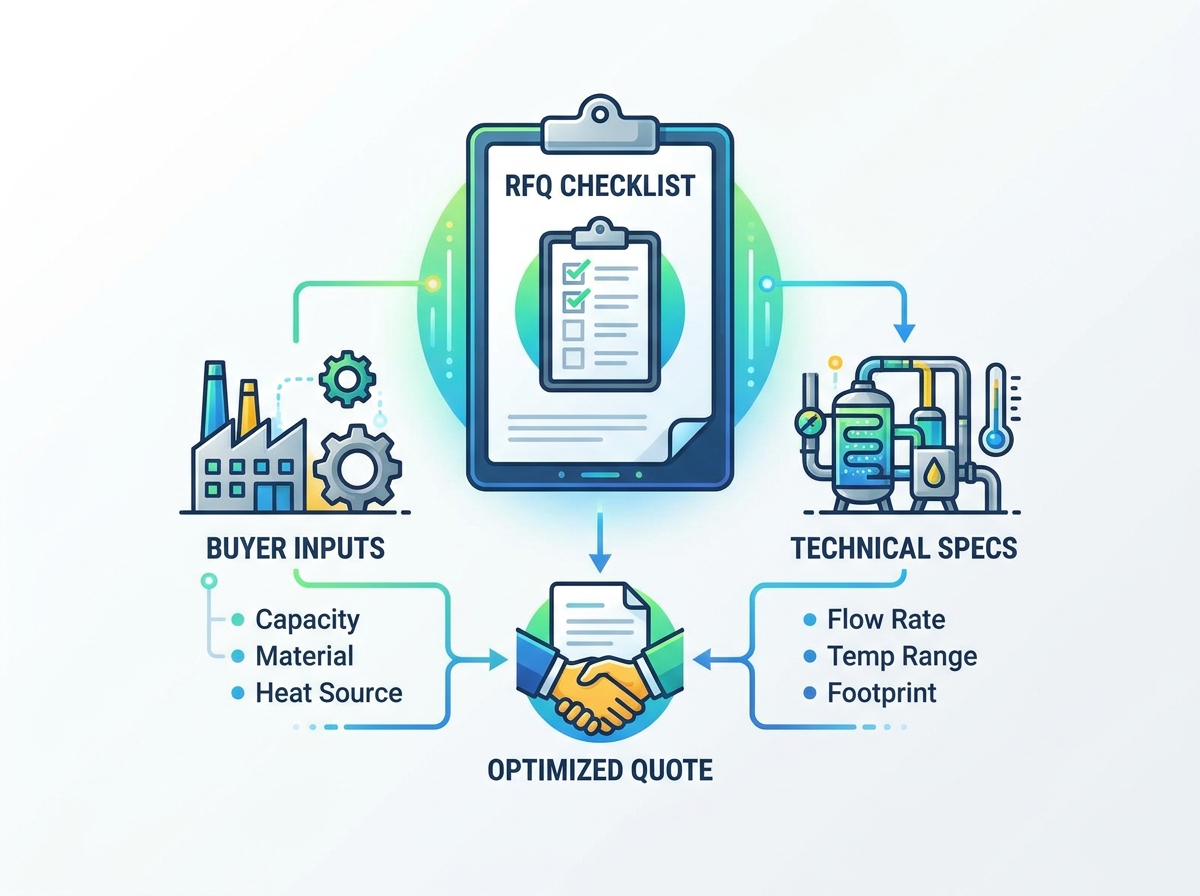
An industrial evaporator RFQ checklist helps buyers prepare the technical information manufacturers need to evaluate equipment requirements and provide accurate, comparable quotations. For chemical processing, industrial wastewater treatment, food production, and other thermal separation applications, a complete RFQ should include feed composition, flow rates, target concentration, operating conditions, available utilities, and material requirements. Additional details such as installation space, automation preferences, and scope of supply help clarify project responsibilities and potential costs. This guide outlines the essential industrial evaporator specifications buyers should provide and explains how these details support equipment design, technology comparison, and supplier evaluation.
Feed Characterization is Non-Negotiable: Precise data on boiling point elevation, viscosity curves, non-condensable gases, and fouling tendencies dictates the fundamental design and technology selection.
Utility Constraints Drive Operating Costs: Clearly defining available steam pressure, cooling water capacity, and electrical limits determines whether thermal (TVR) or mechanical (MVR) vapor recompression is viable.
Metallurgy Dictates CapEx and Lifespan: Providing accurate pH and chloride levels prevents catastrophic corrosion failures and ensures the correct materials of construction are quoted.
Clear Battery Limits Prevent Scope Creep: Defining exact automation preferences, structural steel responsibilities, and physical tie-in points eliminates hidden costs in the procurement process.
Table of Contents
Missing data creates a cascading failure in thermal design. When buyers omit fluid properties, manufacturers guess. This guesswork leads directly to oversized systems that waste massive amounts of energy. Conversely, undersized systems permanently bottleneck plant production. Incorrect metallurgical specifications routinely cause rapid degradation, pitting, and stress corrosion cracking.
Vendors protect themselves against unknown variables. If feed data, site conditions, or battery limits remain poorly defined, manufacturers pad their quotes with expensive risk contingencies. You end up paying for safety margins that are entirely unnecessary if the initial RFQ contains accurate empirical data. Clear specifications eliminate these inflated contingencies. They force vendors to quote based on engineering reality rather than assumed risk.
A rigid specification document forces all bidding manufacturers to align their proposals with your exact success criteria. Without a standardized RFQ, one vendor might quote a bare-bones falling film unit. Another might quote a fully automated forced circulation system with premium metallurgy. Comparing these proposals is impossible.
Providing exact parameters establishes a strict framework for comparing vendor responses. You can accurately evaluate capital expenditure against operating expenditure trade-offs. When every vendor designs their system around the same boiling point elevation, viscosity curves, and utility constraints, you easily identify which manufacturer offers the most efficient heat transfer geometry and compressor selection.
Accurate feed characterization forms the foundation of any thermal separation project. You must define the incoming fluid dynamics with absolute precision.
Total Solids (TS) and Total Dissolved Solids (TDS): Specify initial and final target concentrations. This dictates the total evaporation load and influences the transition point between standard evaporation and crystallization.
Boiling Point Elevation (BPE): Buyers must provide BPE at various concentration stages. As solids concentrate, the solution's boiling point rises above that of pure water. High BPE drastically reduces the available temperature driving force. This directly impacts heat transfer surface area calculations and dictates compressor sizing.
Viscosity and Density Profiles: Detail the requirement for viscosity data at operating temperatures. Viscosity changes dramatically as concentration increases. High viscosity suppresses turbulence, lowers the Reynolds number, and destroys heat transfer coefficients. This data dictates pump sizing, tube velocity, and heat exchanger type selection.
Specific Heat and Thermal Conductivity: Specific heat capacity is required to estimate the sensible heat needed to raise the feed to its operating temperature, while thermal conductivity influences heat transfer behavior. The overall energy balance must also account for the latent heat of vaporization, feed conditions, operating pressure, and any heat recovery within the evaporator system.
Volatiles and Non-Condensable Gases (NCGs): Require data on dissolved gases or volatile organics that flash off during evaporation. NCGs accumulate in the calandria, blinding the heat transfer tubes and destroying efficiency. Knowing the NCG volume allows engineers to properly size the vacuum system and condenser venting arrangements.
Thermal degradation and tube fouling are the two most common operational failures in an industrial evaporator. Addressing them in the RFQ prevents chronic downtime.
Heat Sensitivity: Define maximum allowable temperatures and residence times for products prone to thermal degradation. Food, pharmaceuticals, and active polymers require strict temperature limits to prevent browning, denaturing, or loss of active ingredients. This often forces the design toward high-vacuum operation to lower the boiling temperature.
Scaling and Fouling Potential: Require historical data or pilot testing results on the fluid's tendency to precipitate salts, proteins, or organics. High-fouling fluids require forced circulation designs with high tube velocities to scour the heat transfer surfaces. Low-fouling fluids can utilize highly efficient falling film designs.
Throughput requirements dictate the physical footprint and thermal capacity of the system.
Nominal vs. Peak Feed Rates: Specify the required throughput in kilograms per hour or pounds per hour. Designate normal operating conditions versus absolute maximum peak loads.
Turndown Ratio: Define the minimum acceptable operating capacity during low-production periods. Running a system below its designed turndown ratio compromises stability, destroys tube wetting rates, and leads to severe dry-out and scaling.
The final product state determines the mechanical limits of the separation process. You must define the exact final product specifications required for downstream processing. Whether the concentrated liquor goes to a crystallizer, a spray dryer, or direct packaging, the upstream equipment must hit precise density targets.
Establish acceptable tolerance ranges for the final concentration. Pushing a solution past its saturation point inside the wrong heat exchanger instantly plugs the tubes with crystallized solids. If your target concentration borders on supersaturation, state this clearly so vendors can incorporate appropriate crystallization safeguards.
The evaporated water, or condensate, must go somewhere. Detail the environmental or reuse specifications for this discharge stream. If you intend to reuse the condensate as boiler feed water or clean-in-place (CIP) makeup, the purity requirements are exceptionally high.
Condensate quality requirements should be defined according to the intended reuse or discharge application. Buyers should specify relevant parameters such as COD, BOD, conductivity, ammonia, volatile organic compounds (VOCs), or other contaminants where applicable. The required limits depend on local discharge regulations, reuse standards, and downstream treatment requirements. This information helps evaporator manufacturers evaluate vapor-liquid separation, condenser design, and any additional condensate treatment needs. Mist eliminators can reduce liquid droplet carryover, but dissolved or volatile contaminants may require separate treatment processes.
Equipment design is strictly bound by the utilities available at your facility. A brilliant thermal design is useless if your plant cannot supply the required steam or power.
Steam Supply: Provide available steam pressure at the equipment battery limit and maximum continuous flow rates. Low-pressure steam requires massive heat exchanger surface areas. High-pressure steam allows for more compact designs but may cause thermal degradation.
Cooling Media: Specify cooling water availability, supply temperatures, return temperature limits, and maximum flow rates. Cooling water temperature and flow rate influence condenser performance and the operating pressure that can be maintained within the evaporation system. The achievable vacuum level also depends on condenser design, non-condensable gas loads, vacuum equipment capacity, and system pressure losses. These conditions should be evaluated together when establishing the required evaporation temperature.
Electrical Power: Detail site voltage, phase, frequency, and maximum allowable amp draw. This is critical for Mechanical Vapor Recompression systems, which rely on massive centrifugal fans or turbo-compressors. Specify if soft starters or variable frequency drives (VFDs) are required to manage inrush currents.
Instrument Air and Plant Utilities: Specify the availability, dew point, and pressure of compressed air required for pneumatic control valves and sensitive instrumentation.
Physical space dictates vessel geometry. Provide the maximum allowable footprint (length by width) and absolute vertical clearance. Thermal separation structures often exceed 40 feet in height to accommodate barometric legs and vapor separators. If height is restricted, vendors must design horizontal configurations or utilize mechanical pumps instead of gravity discharge.
Detail constraints regarding bringing large vessels into existing facilities. Specify door dimensions, crane access limitations, floor loading limits, and allowable roof penetrations. Knowing these constraints upfront prevents the nightmare of receiving a vessel that cannot physically enter the building.
Your provided specifications steer vendors toward specific mechanical designs. Understanding this correlation helps you evaluate whether a vendor's proposed technology actually matches your fluid data.
Evaporator Type | Ideal Fluid Characteristics | Key Advantages | Primary Limitations |
|---|---|---|---|
Falling Film | Low viscosity, highly heat-sensitive, low fouling. | High heat transfer coefficients, low residence time. | Cannot handle heavy scaling or suspended solids. |
Forced Circulation | High fouling, crystallizing, high viscosity, heavy slurries. | Resists scaling via high tube velocity, handles solids. | High power consumption for circulation pumps. |
Agitated Thin Film | Extremely viscous, highly heat-sensitive, heavy organics. | Mechanically wipes fluid to prevent degradation. | High capital cost, limited surface area per unit. |
Energy recovery defines your long-term operating costs. State your preference or request a comparative return on investment (ROI) analysis between different configurations based on local utility costs.
Mechanical Vapor Recompression (MVR) uses a mechanically driven compressor to increase the pressure and temperature of generated vapor so that its latent heat can be reused for evaporation. It can substantially reduce external steam demand, although electrical consumption, compressor requirements, and capital costs must be evaluated for the specific application. Thermal Vapor Recompression (TVR) uses high-pressure motive steam to recompress part of the generated vapor and improve steam utilization. Multiple-effect evaporation reuses vapor from one effect as the heating medium for another, reducing fresh steam consumption compared with a comparable single-effect process. Buyers should request an evaluation of suitable energy recovery configurations based on utility availability, local energy costs, operating hours, boiling point elevation, and required evaporation capacity.
Never scale up a novel or highly complex fluid without empirical validation. Request detailed information on the vendor's pilot testing capabilities. Pilot testing validates heat transfer coefficients, confirms fouling rates, and proves the proposed technology before you commit to full-scale fabrication. Vendors who refuse or lack the capability to run pilot tests on complex fluids present a massive project risk.
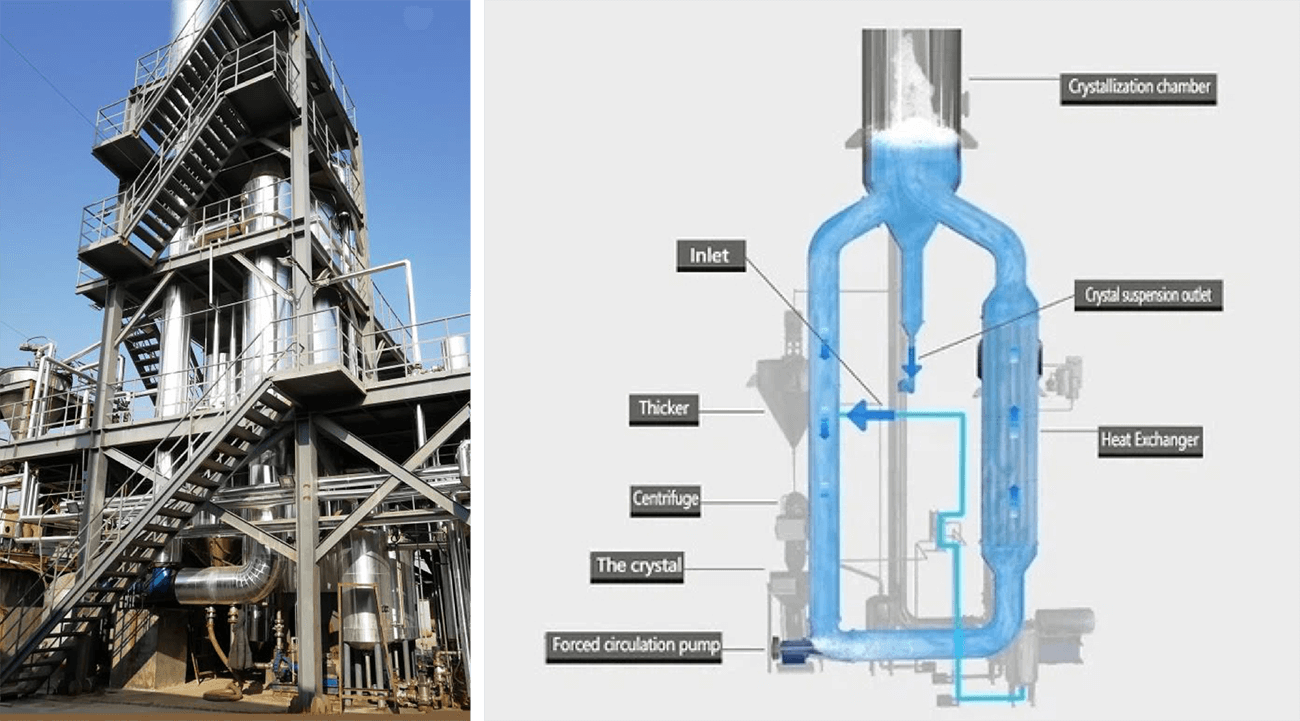
Metallurgy dictates both the capital cost and the lifespan of the equipment. Require exact pH ranges, chloride concentrations, and the presence of specific corrosive agents like fluorides or sulfuric acid in your RFQ.
Material selection for industrial evaporators should consider the actual chemical composition, operating temperature, pH, chloride concentration, and other corrosive constituents of the process fluid. Austenitic stainless steels such as 304 and 316L may be susceptible to localized corrosion or chloride stress corrosion cracking under certain service conditions. More corrosion-resistant materials, including duplex stainless steels, titanium, or selected nickel-based alloys, may be appropriate depending on the application. Buyers should also consider how chemical concentrations change throughout the evaporation process, since different equipment components may experience different corrosion conditions. Material recommendations should be supported by relevant corrosion data, operating experience, or project-specific compatibility assessments.
For food, dairy, and pharmaceutical applications, hygiene is paramount. Specify required surface finishes using exact Ra values. Note all necessary compliance standards, including 3-A, FDA, or cGMP requirements. Define the required CIP protocols, including required flow rates, spray ball coverage, and cleaning chemical compatibilities. The metallurgy and elastomers (gaskets, O-rings) must withstand harsh caustic and acid cleaning cycles without degrading.
Scope creep destroys project budgets. Clearly define the physical tie-in points for all piping and utilities. Use precise language like "flange-to-flange connections at the skid edge."
Specify exactly what the vendor is responsible for supplying. Determine who provides the structural steel, access platforms, stairways, and thermal insulation. Clarify whether feed, discharge, and condensate pumps are included in the vendor's scope or supplied by the plant. Ambiguity here guarantees unexpected invoices during installation.
Detail the required automation architecture. Specify your preferred PLC or DCS platforms, such as Allen-Bradley or Siemens, to ensure seamless integration with your existing plant SCADA systems. List acceptable manufacturers for critical instrumentation, including magnetic flow meters, pressure transmitters, and radar level sensors. Standardizing instrumentation reduces your required spare parts inventory and simplifies troubleshooting for your maintenance team.
Require vendors to include a recommended 1-year and 2-year spare parts list with their initial proposal. This provides visibility into ongoing maintenance costs. Specify spatial requirements for maintenance activities. Ensure the design includes necessary clearance for tube bundle extraction, circulation pump seal replacement, or rotor removal in agitated thin-film units. Equipment that cannot be safely accessed cannot be maintained.
Outline all necessary data regarding local air quality permits and venting requirements. High-capacity vacuum systems exhaust non-condensable gases that may require thermal oxidizers or carbon scrubbers. Include local noise ordinances, specifying maximum allowable decibel limits at the equipment boundary. Large MVR fans and turbo-compressors generate significant noise, often requiring custom acoustic enclosures to meet safety regulations.
Buyers should identify whether the installation site contains hazardous areas involving flammable gases, vapors, or combustible dust. The RFQ should specify the applicable hazardous area classification, local electrical codes, and required equipment protection methods. Depending on the project location, these may include ATEX requirements, NEC hazardous location classifications, or other applicable standards. Electrical enclosure ratings should be specified separately where required and must not be treated as substitutes for hazardous area certification. The presence of flammable solvents in the feed fluid or combustible dust in the surrounding plant environment dictates strict adherence to hazardous area electrical codes. Retrofitting standard equipment for hazardous areas is prohibitively expensive.
Define the required delivery date and the available installation window. Set clear expectations for Factory Acceptance Testing (FAT) and Site Acceptance Testing (SAT). Detail the performance guarantees required for final sign-off, ensuring the vendor remains contractually obligated to hit the target concentration and capacity metrics defined in the RFQ.
Secure accurate, comparable, and technically viable vendor proposals by executing the following steps immediately:
Compile comprehensive fluid data, including lab analysis of viscosity, boiling point elevation, and chlorides, before contacting any manufacturers.
Consult with a process engineer to map out exact utility capacities and physical footprint constraints at your facility.
Define rigid battery limits and automation preferences in writing to prevent scope creep during the procurement phase.
Distribute the standardized specification checklist to a shortlist of vetted, technically capable manufacturers.
Disqualify any vendor who provides a quote without requesting clarification on missing critical data like boiling point elevation or non-condensable gases.
A: The most critical specifications include feed composition, boiling point elevation at various concentrations, viscosity curves at operating temperatures, available site utilities, and exact materials of construction requirements based on fluid pH and chloride levels.
A: Boiling point elevation reduces the effective temperature difference between the heating media and the boiling fluid. A higher elevation requires significantly more heat transfer surface area to achieve the same evaporation rate. In MVR systems, it requires larger compressors to generate the necessary temperature lift.
A: Viscosity dictates fluid flow dynamics. High viscosity suppresses turbulence, which drastically lowers the heat transfer coefficient. Vendors need exact viscosity curves to properly size circulation pumps, determine required tube velocities, and select the correct heat exchanger geometry to prevent fouling and dry-out.
A: Mechanical Vapor Recompression (MVR) uses an electrically driven compressor to recycle vapor, offering high energy efficiency but requiring significant electrical capacity and higher capital costs. Thermal Vapor Recompression (TVR) uses high-pressure motive steam to compress vapor, requiring less capital but demanding a steady supply of high-pressure plant steam.
A: Materials are determined by analyzing the feed fluid's pH, operating temperature, and specific corrosive ions, particularly chlorides. High chlorides and high temperatures cause stress corrosion cracking in standard stainless steel, necessitating upgrades to Duplex stainless steel, Titanium, or Hastelloy alloys.
A: Vendors need the maximum evaporation rate, the temperature of the available cooling water, and the exact volume of dissolved non-condensable gases (NCGs) in the feed. High cooling water temperatures limit vacuum depth, while high NCG volumes require significantly larger vacuum pumps to prevent system pressurization.
A: The turndown ratio defines the minimum acceptable operating capacity. Designing for a high turndown ratio requires specialized liquid distributors, variable frequency drives on pumps, and advanced control logic to maintain tube wetting rates at low flows. This increases the initial capital cost but prevents dry-out during low-production periods.

