
Views: 0 Author: Site Editor Publish Time: 2026-11-24 Origin: Site


Multiple effect evaporation for salt production are widely used in modern salt factories because they reuse the heat from generated vapor to reduce fresh steam consumption during brine concentration and salt production. By operating several evaporation effects at progressively lower pressures and temperatures, these systems improve steam economy compared with conventional single-effect evaporation. For industrial salt manufacturers, this approach can help reduce thermal energy costs while supporting continuous brine concentration and crystallization. The actual performance depends on the number of effects, brine composition, boiling point elevation, and overall system design.
Modern salt factories solve this core business problem through advanced thermal engineering. They decouple production output from energy costs by implementing multiple effect evaporation for salt production. This technology utilizes latent heat recovery to fundamentally alter plant economics. It cascades vapor through successive pressure zones, reusing energy multiple times before it reaches the condenser. Upgrading to these systems improves overall sustainability while drastically reducing boiler fuel consumption.
Steam Economy Maximization: Multiple effect evaporation increases the steam economy (kg of water evaporated per kg of live steam) from <0.9 in single-effect systems to 3.0–5.0+ depending on the number of effects.
Boiling Point Elevation (BPE) Limits: In NaCl production, the high BPE of saturated brine dictates the maximum viable number of effects, typically capping practical designs at 4 to 6 stages.
Scaling and U-Value Degradation: Effective system design must prioritize forced circulation over falling film in crystallization stages to prevent catastrophic scaling and maintain the overall heat transfer coefficient (U-value).
CapEx vs. OpEx Trade-off: Adding effects reduces ongoing steam costs but requires a linear increase in capital expenditure for heat exchangers and vessels; the optimum number requires site-specific thermodynamic modeling.
Table of Contents
Single-stage evaporation represents the baseline inefficiency in thermal separation. You inject live steam into the heat exchanger to boil the brine. The brine releases water vapor. In a single-effect system, the latent heat of this generated vapor is entirely lost to the cooling condenser. It escapes the process loop permanently. You must burn fresh boiler fuel for every single ton of water removed. This thermodynamic dead-end makes high-volume salt production financially unviable in regions with high energy costs.
Multiple effect systems solve this by establishing a cascading pressure and temperature profile. The vapor generated in the first effect does not go to a condenser. Instead, it serves as the heating medium for the second effect. To make this heat transfer possible, the second effect must operate at a lower pressure. Lower pressure reduces the boiling point of the brine inside that vessel. This allows the vapor from the first effect to successfully boil the liquor in the second effect.
Energy reuse becomes a mathematical reality in continuous salt production. A triple-effect evaporation system can approach a steam economy of approximately three kilograms of water evaporated per kilogram of live steam under favorable conditions. Actual performance depends on feed temperature, boiling point elevation, heat losses, condensate heat recovery, and the operating conditions of each effect. The latent heat transfers across the tube walls, condensing the vapor while boiling the adjacent brine. This cascade continues until the final effect, where the remaining vapor finally meets the surface condenser. This drastically cuts the required live steam input.
Venting non-condensable gases is another strict thermodynamic requirement. Air and other dissolved gases enter the system with the raw brine. If left inside the vapor bodies, these gases blanket the heat transfer tubes. This gas blanketing severely drops the U-value. Operators must continuously vent these gases from each effect to the final vacuum system to maintain peak thermal efficiency.
Thermal optimization extends beyond vapor reuse. Plant engineers also capture sensible heat from the liquid condensate. As vapor condenses in the higher-pressure effects, it forms hot, high-pressure liquid water. Routing this hot condensate directly to lower-pressure effects causes it to flash into steam. This flashing process generates additional secondary vapor without requiring any new energy input.
Recovering this sensible heat serves another practical purpose. You can use it to preheat the incoming raw brine liquor. Cold feed brine consumes massive amounts of live steam just to reach its boiling point. Preheating the feed with recovered condensate reduces the live steam requirement in the first effect. It optimizes the design liquid flow and ensures the primary heat exchanger focuses entirely on evaporation rather than sensible heating.
Handling high-salinity, precipitating fluids requires specific evaporator geometries. Standard water evaporators fail rapidly when processing saturated brine. You must select configurations designed specifically for heavy crystal slurries. The feed sequence and circulation method dictate the reliability of the entire plant.
Falling film evaporators work exceptionally well for pre-concentration. They handle unsaturated brine efficiently. Falling film evaporators are generally better suited to pre-concentration stages where the brine remains sufficiently fluid and significant crystal formation can be avoided. As the solution approaches crystallization conditions, suspended solids and scale formation may interfere with film distribution and heat transfer. Forced circulation crystallizers are often preferred for these stages because they maintain slurry circulation and can reduce boiling directly on heat transfer surfaces. However, scaling risks still depend on brine chemistry, circulation conditions, and equipment design.
Forced circulation relies on high-velocity axial flow pumps. These massive pumps push the brine slurry through the heat exchanger tubes at high speeds. The velocity keeps the salt crystals in constant suspension. More importantly, the high hydrostatic pressure suppresses boiling at the tube wall. The brine only flashes into vapor once it enters the main separator vessel. Preventing boiling inside the tubes stops localized supersaturation, which prevents catastrophic tube plugging.
The design of the main separator vessel also dictates product quality. The vessel must provide adequate residence time for crystal growth. If the residence time is too short, the system produces fine, dusty salt that causes handling problems downstream. A properly sized separator allows crystals to grow to the desired mesh size before extraction.
The direction of brine flow relative to steam flow impacts system efficiency. Forward feed moves both brine and steam in the same direction. The raw feed enters the first, highest-temperature effect. It then flows toward the cooler, lower-pressure effects. This configuration works well for thermally sensitive operations. It requires fewer inter-effect pumps because the pressure gradient naturally drives the liquid forward.
Backward feed moves the brine counter to the steam flow. The raw feed enters the last, coldest effect and gets pumped backward to the hottest first effect. Backward feed arrangements can be advantageous in selected salt evaporation applications, particularly when concentrated liquor becomes more viscous at lower temperatures. Processing the more concentrated brine in a higher-temperature effect may improve fluidity and heat transfer, although the preferred feed arrangement depends on brine properties, boiling point elevation, pump requirements, and overall energy balance. This improves the overall heat transfer coefficient and reduces the pumping power required.
Mixed and parallel feed configurations offer advanced optimization strategies. Parallel feed injects raw brine into every effect simultaneously. This works well when the feed is already close to saturation. Mixed feed combines forward and backward principles to optimize design liquid flow. These complex sequences help manage concentration gradients across multiple vessels, balancing the thermal load perfectly.
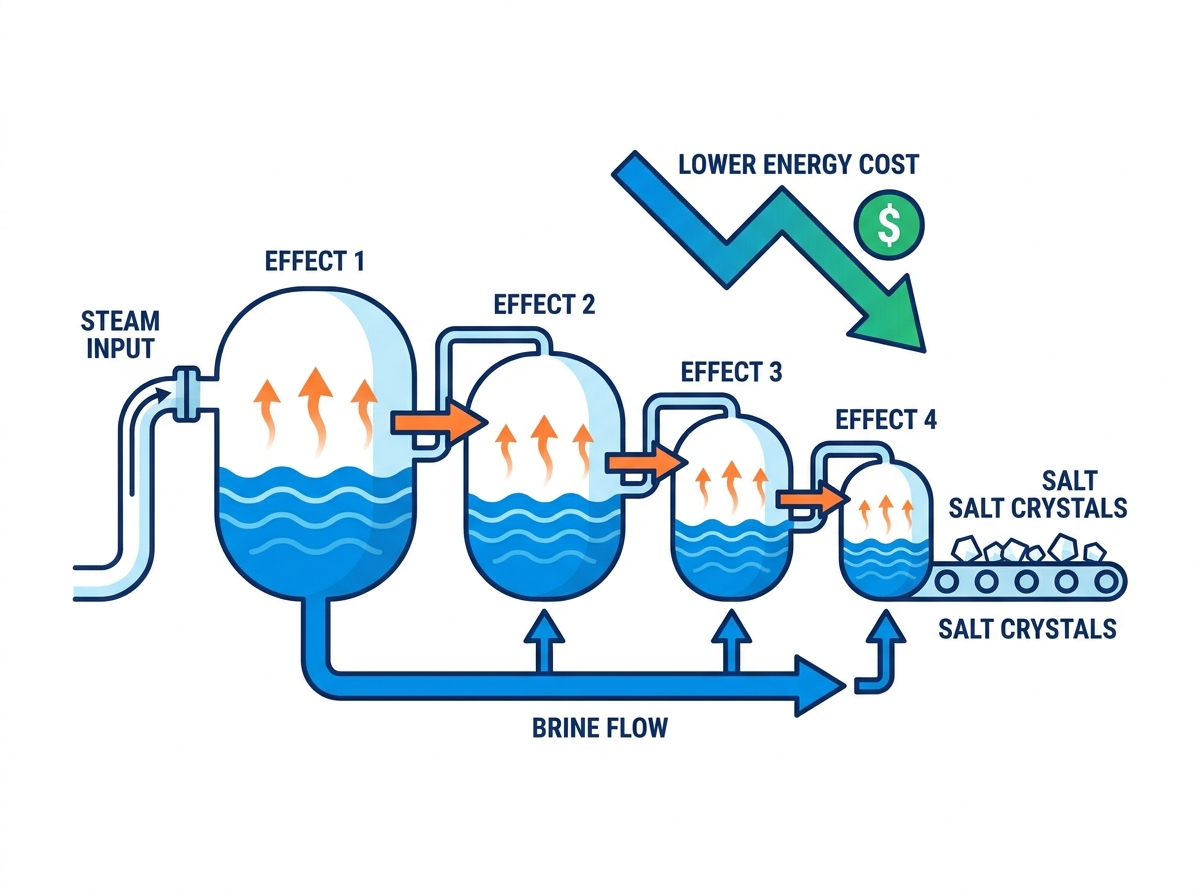
Sizing a multiple effect evaporation system requires a strict decision framework. You cannot simply add infinite effects to achieve zero steam consumption. The engineering reality involves diminishing thermodynamic returns and physical temperature constraints.
The cost curve dictates the practical limit of system expansion. Adding an effect reduces ongoing steam costs. However, it requires a linear increase in capital expenditure. You must purchase another massive titanium vessel. You need another shell-and-tube heat exchanger. You must install additional axial flow pumps, heavy piping, and instrumentation. The annualized savings in boiler fuel must justify this massive upfront investment.
Local steam costs heavily influence the final configuration. In regions with abundant, low-cost thermal energy, a 3-effect system often provides the best return on investment. The fuel savings of a fourth effect would not pay for the extra equipment. Conversely, in regions with expensive energy, a 5-effect or even 6-effect system becomes mandatory. Plant lifecycle expectations and utility pricing models ultimately dictate the optimum number.
Thermodynamics imposes a hard physical limit on salt evaporators. This limit is Boiling Point Elevation (BPE). Pure water boils at 100°C at atmospheric pressure. Saturated sodium chloride brine boils at approximately 109°C under the same conditions. This 9°C difference is the BPE. The vapor generated by boiling brine is only at 100°C, even though the liquid is at 109°C.
Boiling Point Elevation (BPE) reduces the effective temperature difference available for heat transfer in multiple-effect evaporation systems. The actual BPE varies with salt concentration, operating pressure, temperature, and solution composition, so it should be calculated separately for each effect. As additional effects are introduced, the total available temperature difference must be distributed across more heating stages while accounting for BPE, pressure losses, and the minimum temperature difference required for heat transfer. These constraints limit the practical number of effects, but the final configuration should be determined through process simulation and economic evaluation rather than applying a universal four-to-six-effect limit.
Operating thermal separation equipment in highly corrosive, scaling environments presents harsh realities. You must engineer the system to withstand constant chemical attack and mechanical wear. Ignoring these risks leads to massive downtime and ruined equipment.
Scaling is the primary enemy of multi-effect evaporators. Calcium sulfate impurities in raw brine cause severe scaling. Unlike sodium chloride, calcium sulfate exhibits inverse solubility. It becomes less soluble as temperatures rise. It precipitates directly onto the hottest heat transfer surfaces. Localized supersaturation accelerates this process, forming a rock-hard insulative layer inside the tubes.
This scaling directly reduces the effective heat transfer area. The overall heat transfer coefficient (U-value) degrades rapidly. To combat this, engineers must incorporate generous fouling factors into the initial heat exchanger design. You must over-size the surface area to maintain production capacity as the tubes foul.
Mitigation requires aggressive operational strategies. Facilities use elutriation legs to separate clear liquor from the crystal slurry. Strict control of magma density ensures enough salt crystals remain in suspension to act as scouring agents. These circulating crystals physically scrub the tube walls. Furthermore, operators must schedule regular wash cycles and chemical boil-outs to dissolve scale and restore heat transfer efficiency.
To maintain peak performance, operators typically follow a strict maintenance sequence:
Monitor the steam pressure in the first effect daily to detect early signs of fouling.
Perform a hot condensate wash every 48 to 72 hours to dissolve soft salt deposits.
Execute a full chemical boil-out using weak acid solutions during scheduled monthly shutdowns to remove hard calcium sulfate scale.
Inspect axial flow pump impellers quarterly for erosion caused by the abrasive salt slurry.
Calibrate magma density sensors weekly to ensure the crystal suspension remains within the optimal scouring range.
Symptom | Probable Cause | Corrective Action |
|---|---|---|
Sudden drop in steam economy | Vapor leak or venting failure | Inspect vapor ducting and non-condensable gas vents. |
Gradual loss of evaporation capacity | Tube scaling (Calcium Sulfate) | Initiate chemical boil-out and verify magma density. |
High vibration in circulation pump | Impeller erosion or cavitation | Check pump suction head and inspect impeller for wear. |
Poor salt crystal size distribution | Inadequate residence time | Adjust elutriation leg flow rate and separator level. |
Hot, concentrated chlorides destroy standard metals. You must evaluate metallurgical requirements carefully to prevent stress corrosion cracking and pitting. Selecting the wrong alloy guarantees catastrophic failure within months of commissioning.
Material | Corrosion Resistance in Hot Brine | Lifecycle Cost Implications | Primary Application in MEE Systems |
|---|---|---|---|
Standard 316L Stainless | Poor (Highly susceptible to pitting and SCC) | High replacement frequency | Low-temperature, low-chloride pre-treatment only |
Duplex Stainless (SAF 2205/2507) | Good (Resists SCC better than 316L) | Moderate upfront cost, good longevity | Vapor bodies, lower-temperature effects |
Titanium (Grade 2 or 12) | Excellent (Immune to chloride attack) | High upfront cost, virtually zero replacement | Heat exchanger tubes, high-temperature first effect |
Monel 400 | Excellent (Strong resistance to reducing salts) | Very high upfront cost | Specialty applications with high abrasive wear |
Titanium remains the industry standard for heat exchanger tubes in the hottest effects. Its immunity to chloride pitting justifies the high upfront expense. Duplex stainless steels provide a reliable alternative for vapor bodies and cooler effects, balancing capital costs with operational longevity.
Modern salt factories leverage their thermal systems for dual-purpose environmental and production goals. Expanding the value proposition beyond pure sodium chloride extraction transforms the facility's overall utility footprint.
The evaporation process inherently acts as a massive thermal desalination system. While the primary goal is concentrating brine to yield salt crystals, the byproduct is massive volumes of vapor. When this vapor condenses, it yields high-purity distilled water. You separate the solvent from the solute entirely.
This recovered water offers immense economic benefits. Facilities rarely discharge it. Instead, they reuse this distilled water for critical plant operations. It serves as perfect, mineral-free boiler feed water, reducing chemical treatment costs. Operators use it for equipment washdowns and pump seal flushes. In arid regions, salt plants often supply this excess high-purity water to local municipal networks, creating a secondary revenue stream.
Environmental regulations increasingly mandate Zero Liquid Discharge (ZLD) frameworks. Facilities must completely eliminate liquid waste streams to protect local watersheds. Multi-effect systems play a central role in achieving ZLD compliance.
Industrial plants, such as power stations or textile mills, generate massive volumes of reject brine from reverse osmosis (RO) plants. RO can only concentrate water to a certain point before osmotic pressure overwhelms the membranes. MEE systems take this RO reject brine and concentrate it further. They drive the liquid to total saturation, forcing the dissolved solids to crystallize. This process turns a toxic disposal liability into a crystallized salt asset, allowing the facility to achieve strict ZLD mandates.
Contextualizing multiple effect evaporation against competing modern thermal separation methods ensures proper technology selection. Plant engineers must weigh overall value influencing factors before committing to a specific design architecture.
Multiple-Effect Evaporation (MEE) and Mechanical Vapor Recompression (MVR) both improve energy utilization by recovering heat from generated vapor, but they use different approaches. MEE transfers secondary vapor between effects operating at progressively lower pressures, reducing fresh steam consumption. MVR uses a mechanical compressor to increase the pressure and temperature of generated vapor so that its latent heat can be reused within the evaporation process.
MEE may be attractive where suitable thermal energy is available and the process benefits from multiple evaporation stages. MVR can reduce external steam requirements but introduces electrical demand and compressor-related operating considerations. Both technologies require appropriate heat exchanger design, fouling control, maintenance access, and auxiliary equipment. Buyers should compare the technologies based on brine composition, boiling point elevation, evaporation capacity, utility prices, available infrastructure, and total lifecycle costs.
Large-scale facilities often explore the architecture of combining MVR and MEE. This hybrid approach leverages the strengths of both technologies. Engineers use an MVR system for the bulk evaporation phase. The MVR efficiently handles the low-concentration brine, stripping away massive volumes of water using electrical power.
Once the brine approaches saturation, the Boiling Point Elevation spikes. MVR compressors struggle against high BPE because they can only generate a limited temperature lift. At this point, the plant feeds the concentrated brine into a smaller MEE train. The MEE train handles the final high-BPE crystallization phase using high-pressure live steam. Specific plant capacities and complex utility pricing structures justify this hybrid capital expenditure, optimizing both electrical and thermal loads.
Multiple effect evaporation remains the undisputed industry standard for salt production where reliable, low-cost thermal energy is available. It offers a robust, field-proven balance of steam economy, freshwater recovery, and operational simplicity. By cascading vapor through successive pressure zones, facilities can drastically cut boiler fuel consumption while maintaining massive continuous production volumes.
Engineering teams must base their technology selection on a strict evaluation matrix. You must analyze local steam costs versus electrical rates. You must evaluate cooling water availability and strict environmental ZLD mandates. Finally, you must profile the specific impurities in your raw brine to anticipate scaling risks and material degradation.
To move forward successfully, take the following actions:
Initiate a comprehensive front-end engineering design (FEED) study focusing on mass and energy balances.
Execute rigorous BPE modeling based on your specific brine chemistry before committing to a specific number of effects.
Analyze local utility costs over a 10-year horizon to accurately map the capital expenditure versus operational expenditure trade-off.
Consult with metallurgists to select the appropriate titanium or duplex alloys for your highest-temperature vessels.
A: The steam economy typically ranges from 3.0 to 4.5 kilograms of water evaporated per kilogram of live steam. This depends heavily on the total number of effects installed and the efficiency of the sensible heat recovery from condensate flashing.
A: Falling film evaporators suffer immediate scaling and tube blockage when precipitating solids contact the heat transfer surface. They lack the high-velocity liquid flow required to keep salt crystals in suspension, rapidly reducing the heat transfer area and causing system failure.
A: Boiling Point Elevation reduces the effective temperature difference between heating vapor and boiling brine in each effect. Since BPE depends on salt concentration and operating conditions, its impact must be evaluated for every stage of the evaporation system. Higher BPE can reduce the temperature difference available for heat transfer and limit the number of economically practical effects.
A: The solvent—pure water—is driven off the brine solution as vapor. This leaves behind a supersaturated liquor that yields salt crystals. The evaporated water condenses into high-purity distilled water, which is often recovered for boiler feed or local desalination purposes.
A: Operators clean scaling through routine condensate wash cycles and targeted chemical boil-outs to dissolve calcium sulfate. Additionally, maintaining proper magma density allows suspended salt crystals to act as physical scouring agents, constantly scrubbing the heat transfer tubes during operation.
A: Salt production often leans toward backward or mixed feed configurations. Backward feed pumps the most concentrated, highly viscous brine into the hottest first effect. The higher temperature lowers the brine's viscosity, improving heat transfer and optimizing liquid flow through the pumps.
A: MEE relies on thermal energy (live steam) cascaded through multiple pressure vessels to drive evaporation. MVR uses electrical energy to power a mechanical compressor, which compresses the generated vapor to reuse its latent heat within a single vessel.

