
Views: 0 Author: Site Editor Publish Time: 2026-10-13 Origin: Site


Industrial evaporation processes are shifting away from fossil-fuel-based steam generation toward electrified, high-efficiency systems. Plant managers prioritize decarbonization and energy mitigation to meet modern emission standards. While Mechanical Vapor Recompression promises drastic reductions in thermal energy consumption, engineers must accurately calculate the new electrical load. You need this data to justify the initial capital expenditure and determine the true return on investment. This guide breaks down exact electricity consumption metrics and explores the operational variables that dictate power draw. We detail the technical evaluation criteria required for system selection, helping you determine if this technology fits your facility's specific capacity. We also analyze how feed characteristics impact overall efficiency, providing a clear roadmap for integrating electrified evaporation into your existing plant infrastructure.
Standard Consumption: Modern MVR systems typically consume between 15 and 35 kWh of electricity per ton of water evaporated, depending on feed chemistry, system design, and upstream supplier component quality.
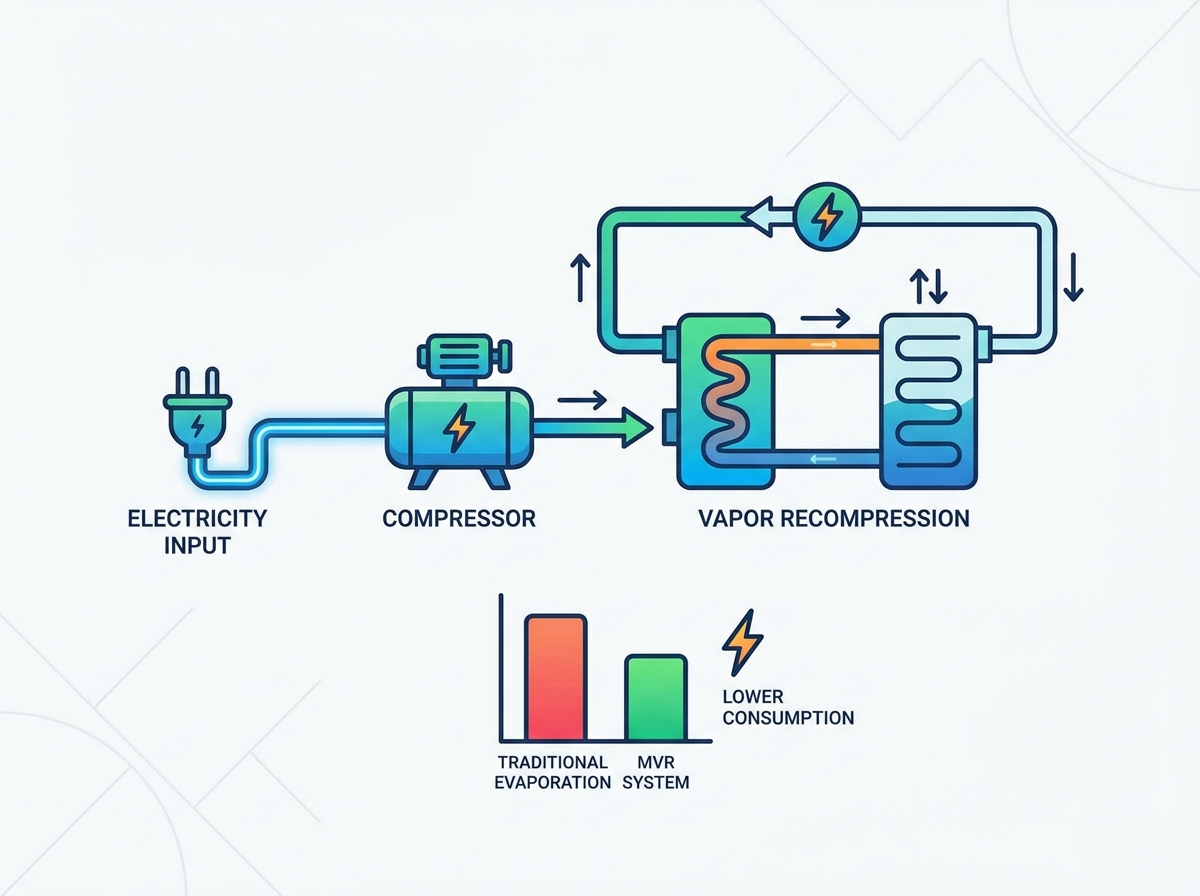
The Energy Trade-off: Mechanical Vapor Recompression can reduce thermal energy (steam) costs by over 90%, shifting the operational expense almost entirely to electrical power for the compressor.
Critical Constraint: Boiling Point Elevation (BPE) is the primary factor dictating compressor work; high BPE requires higher compression ratios, exponentially increasing electricity consumption.
Ideal Use Case: MVR yields the highest ROI in continuous, high-capacity operations (segmented into <50 ton/h, 50 to 100 ton/h, and >100 ton/h) such as chemical wastewater concentration, where local electricity rates are stable and steam generation costs are prohibitive.
Table of Contents
Establishing a realistic operational expenditure baseline requires hard data before committing to extensive feasibility studies. Engineers need precise metrics to evaluate system viability. The core question always comes down to power draw and how much electricity the compressor actually needs to maintain the evaporation cycle.
Modern MVR evaporators typically consume approximately 15–35 kWh per ton of evaporated water, depending on wastewater composition, boiling point elevation (BPE), and system design. By compressing and reusing secondary vapor as a heating source, MVR technology significantly reduces external steam demand. Actual energy efficiency depends on compressor performance, heat transfer conditions, and feed characteristics.
Application Type | Typical BPE (°C) | Estimated Power Consumption (kWh/ton) | Evaporator Configuration |
|---|---|---|---|
Dairy / Milk Concentration | 0.5 - 1.5 | 12 - 18 | Falling Film |
Landfill Leachate | 2.0 - 4.0 | 18 - 25 | Falling Film / Forced Circulation |
Sodium Chloride Crystallization | 8.0 - 10.0 | 28 - 35 | Forced Circulation |
Heavy Chemical Brines | 12.0 - 18.0 | 35 - 45+ | Multi-Stage Forced Circulation |
Vendors often claim a 90% reduction in thermal energy. This claim holds up under rigorous engineering analysis. Traditional multi-effect systems consume vast quantities of live steam and require significant cooling water to condense the final vapor. The mechanical approach eliminates the need for a final condenser and the continuous demand for live motive steam.
Consider the comparative energy balance. The latent heat recovered from the vapor is massive. Water requires roughly 2260 kJ/kg to vaporize. Generating this from scratch takes immense thermal energy. The compressor only inputs enough electrical energy to overcome the temperature difference, known as the delta T. The electrical energy input is a fraction of the latent heat. You shift your operational expense almost entirely to the electrical grid, making the system highly sensitive to local power rates.
To put this into perspective, one ton of steam contains approximately 600 kWh of thermal energy. A traditional single-effect evaporator uses one ton of steam to evaporate one ton of water. A mechanical system uses 15 to 35 kWh of electricity to achieve the exact same evaporation rate. This represents a Coefficient of Performance (COP) ranging from 17 to 40, far exceeding standard heat pump efficiencies.
The 15 to 35 kWh/ton baseline is a starting point. Specific process conditions drastically alter actual power consumption. You must evaluate several technical dimensions that directly dictate your operational outcomes and electrical load.
Boiling Point Elevation (BPE) increases the temperature required for evaporation and directly affects compressor energy consumption. High-BPE liquids require greater temperature lift and compression ratios, increasing power demand. Accurate BPE evaluation helps optimize compressor sizing, energy efficiency, and system performance.
Wastewater viscosity affects heat transfer efficiency and circulation requirements. As dissolved solids become concentrated, viscosity may increase, reducing heat exchanger performance. Proper system design balances heat transfer area, circulation velocity, and compressor power to maintain efficient evaporation.
MVR compressor selection depends on evaporation capacity, vapor flow, and required temperature lift. Roots blowers are commonly used for smaller systems requiring suitable pressure increases, while centrifugal compressors serve larger vapor flow applications. Selecting an efficient compressor helps reduce electricity consumption and improve system reliability.
MVR energy efficiency can be improved through heat recovery and optimized heat exchanger design. Using hot condensate and concentrated liquid to preheat incoming wastewater reduces external heating demand. Suitable falling film configurations can also improve heat transfer efficiency and reduce compressor energy requirements.
MVR evaporators use electrically driven compressors to recycle vapor heat, reducing the need for external steam. Multi-Effect Evaporators (MEE) reuse heat across multiple stages but still require a steam supply. The preferred technology depends on electricity prices, steam availability, water consumption, and operating costs.
MVR systems use mechanical compressors powered by electricity, while Thermal Vapor Recompression (TVR) uses high-pressure steam ejectors to recover vapor energy. TVR is suitable for facilities with available motive steam, whereas MVR may provide greater operating cost savings where electricity is economical.
MVR systems often require higher initial investment due to compressors, specialized materials, and advanced equipment design. However, reduced steam consumption can lower long-term operating costs. Buyers should evaluate electricity prices, maintenance expenses, equipment lead times, and supplier reliability before purchasing.
Reliable electrical power is essential for continuous MVR operation. Voltage fluctuations and unexpected outages can interrupt compressor performance and wastewater treatment. Facilities should assess electricity tariffs, grid capacity, VFD compatibility, and power quality to determine operational feasibility.
MVR evaporators typically require less installation space than multi-effect systems, making them suitable for space-constrained facilities. However, advanced automation and compressor monitoring require trained operators. Proper PLC control, vibration monitoring, and preventive maintenance support stable operation.
Liquid carryover and heat exchanger fouling are major risks in MVR systems. Vapor-liquid separators and demisters help protect compressor components, while Clean-in-Place (CIP) systems reduce scaling on heat transfer surfaces. Regular inspections and condition monitoring help maintain equipment reliability.
MVR systems perform most efficiently under stable operating conditions. Fluctuating wastewater flow can affect compressor efficiency and system stability. Variable Frequency Drives (VFDs), buffer tanks, and suitable control strategies help manage changing loads while maintaining reliable evaporation.
MVR installation requires adequate electrical capacity and compatibility with existing plant utilities. Large compressors may require transformer upgrades, suitable motor controls, and additional electrical protection. Early infrastructure assessments help prevent installation delays and ensure safe commissioning.
Initiate a comprehensive feed chemistry analysis to determine your exact Boiling Point Elevation across the entire concentration curve.
Audit your local utility rates, specifically mapping peak electricity costs against your current steam generation expenses.
Engage with an original equipment manufacturer for a preliminary energy balance and technical feasibility study.
Conduct a facility-level electrical load study to verify transformer and grid capacity for high-horsepower compressor motors.
Specify heat exchanger metallurgy based on a detailed chloride and pH analysis of your process fluid.
A: MVR systems typically consume between 15 and 35 kWh of electricity per ton of water evaporated, though this can vary based on the boiling point elevation, compressor efficiency, and specific design methods used to mitigate energy usage.
A: Yes, during steady-state continuous operation, it can eliminate the need for live motive steam. However, a small amount of startup steam is usually required to bring the system up to operating temperature before the compressor engages.
A: Boiling Point Elevation increases the temperature difference the compressor must overcome. A higher BPE requires a higher compression ratio, which exponentially increases the electrical power required to drive the compressor.
A: Centrifugal compressors are generally best for capacities exceeding 50 ton/h. They handle massive vapor volumes efficiently. For smaller capacities or high compression ratios, positive displacement Roots blowers are typically utilized.
A: High-speed compressor impellers are highly sensitive to liquid droplets. Liquid carryover causes severe erosion and rotor imbalance. High-efficiency demisters ensure only dry vapor enters the machine, preventing catastrophic mechanical failure.

