
Views: 0 Author: Site Editor Publish Time: 2026-11-23 Origin: Site


The vacuum evaporator operating pressure directly affects the boiling temperature of a liquid, the available temperature difference for heat transfer, and the overall evaporation performance. By reducing the pressure inside the evaporation chamber, Vacuum evaporator can process liquids at lower temperatures, making them suitable for heat-sensitive products, chemical recovery, and industrial wastewater treatment. However, selecting the right operating pressure requires more than simply achieving a deeper vacuum. Engineers must also consider the fluid's boiling point elevation (BPE), viscosity, heating capacity, condenser performance, and vacuum pump configuration. Understanding these factors helps equipment buyers evaluate system efficiency, product quality, and long-term operating costs.
Boiling Point Depression: Operating under a vacuum artificially lowers the boiling point of liquids, allowing for evaporation at significantly reduced temperatures, which is critical for thermally sensitive materials.
Energy Efficiency (OPEX): Lower boiling temperatures increase the temperature differential ($\Delta$T) between the heating medium and the fluid, optimizing heat transfer and reducing overall energy requirements.
Process Stability: Stable vacuum pressure, adequate heating capacity, and effective vapor separation help maintain consistent evaporation performance as feed concentration and viscosity change.
Equipment Specification: Selecting the correct vacuum evaporator requires evaluating the trade-offs between deep vacuum capabilities, vacuum pump maintenance costs, fluid properties, and the specific Boiling Point Elevation (BPE) characteristics of the target fluid.
Table of Contents
When you heat a liquid, its molecules gain kinetic energy. Vaporization happens exactly when the liquid's internal vapor pressure equals the pressure exerted by the surrounding atmosphere. In a standard open vessel on the plant floor, water requires 100°C to reach an atmospheric pressure of 760 mmHg (1 atm). By sealing the vessel and mechanically extracting the air, operators drop the internal environmental pressure. This mechanical shift dictates that water molecules require far less kinetic energy to escape the liquid phase and enter a gaseous state.
Dropping the internal pressure changes the entire thermal profile of the industrial facility. It opens up the immediate possibility of using low-grade waste heat rather than relying on expensive, high-pressure live steam generated by fossil fuel boilers. To illustrate how pressure manipulation impacts the boiling threshold, consider the standard pressure-to-temperature correlation for water:
Absolute Pressure (mbar) | Absolute Pressure (mmHg) | Boiling Point of Water (°C) | Typical Industrial Application |
|---|---|---|---|
1013 | 760 | 100 | Standard atmospheric boiling |
300 | 225 | 69 | Mechanical Vapor Recompression (MVR) |
100 | 75 | 45 | Low-temperature chemical recovery |
42 | 31.5 | 30 | Heat pump vacuum evaporation |
Operating a vacuum evaporator at an absolute pressure of approximately 42 mbar allows pure water to boil at around 30°C. This lower boiling temperature may make it possible to use low-grade waste heat or heat pump systems as the heating source, provided they can deliver sufficient heat at a temperature above the boiling solution. The actual feasibility depends on the available temperature difference, heat transfer requirements, and operating conditions.
As evaporation removes water or another solvent, the remaining solution becomes more concentrated. Dissolved salts, sugars, and other non-volatile components increase the solution's boiling temperature relative to that of the pure solvent at the same pressure. This phenomenon is known as Boiling Point Elevation (BPE).
BPE reduces the effective temperature difference between the heating medium and the boiling solution. As concentration increases, the available temperature difference may become smaller, reducing the heat transfer rate and limiting evaporation capacity. The extent of BPE depends on the composition and concentration of the solution.
Vacuum operation helps lower the boiling temperature by reducing the operating pressure. However, it does not eliminate BPE. Engineers must account for both the pressure-dependent boiling temperature and the solution's BPE when determining the operating conditions. Proper pressure selection, heating capacity, and heat exchanger sizing help maintain sufficient temperature differences throughout the concentration process.
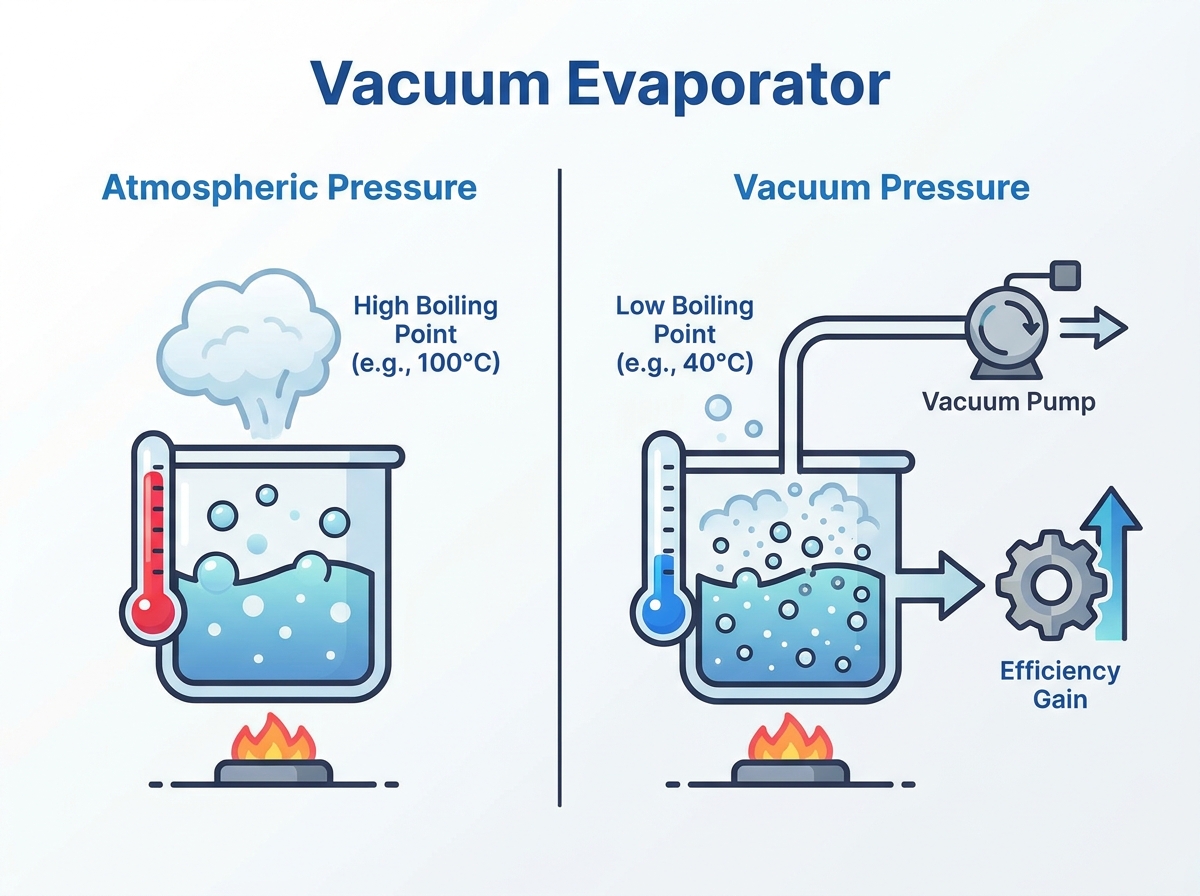
Engineers must match the vacuum depth to the specific industrial application. Over-specifying the vacuum depth wastes capital; under-specifying it ruins the product. Moderate vacuum systems generally operate between 100 and 300 mbar. These systems handle standard industrial wastewater volume reduction effectively. They require less robust vacuum pumps, simplifying routine maintenance and reducing initial capital expenditure. Maintaining mechanical seal integrity remains straightforward under these moderate conditions, minimizing unexpected downtime.
Conversely, deep vacuum systems or molecular distillation units operate at fractions of a millibar. These specialized units process high-value, highly sensitive separations, such as active pharmaceutical ingredients or complex polymer chains. Operating at a deep vacuum fundamentally alters the molecular mean free path. The physical distance a vapor molecule travels before colliding with another molecule increases significantly. This extended path prevents molecular collision, unwanted side reactions, and the thermal degradation of delicate compounds.
When deciding between moderate and deep vacuum, plant engineers should follow a strict evaluation sequence:
Assess the absolute thermal degradation limit of the target compound.
Calculate the required molecular mean free path for the specific separation.
Evaluate the facility's maintenance capacity to uphold deep vacuum seals and service high-end diffusion or dry screw pumps.
Determine the cooling water temperature available for the condenser, as this dictates the maximum achievable vacuum depth.
Many operators mistakenly believe vacuum pressure alone drives the speed of evaporation. In reality, the available heating power exerts the most significant influence on the overall vaporization rate. Lowering the pressure simply removes the thermal barrier to boiling. The system must still supply sufficient latent heat to drive the actual phase change from liquid to gas. Fluid properties heavily dictate how effectively this heat transfers across the exchanger surfaces.
High specific heat capacity means the fluid absorbs more energy before changing temperature. Poor thermal conductivity acts as an insulator, slowing down the process. As the fluid concentrates, viscosity inevitably increases. Thick, viscous fluids resist convective mixing inside the boiling chamber. This physical resistance degrades the overall heat transfer coefficient (U-value). Operators must balance the operating pressure against the available thermal input to maintain target throughput and prevent system bottlenecks. If you pull a deep vacuum but lack the thermal wattage to push the latent heat into the fluid, the evaporation rate will flatline.
Operating pressure and pressure differential are important but different parameters in vacuum evaporation systems. Operating pressure refers to the absolute pressure maintained inside the evaporation chamber, while pressure differential describes the pressure difference between two points or process stages.
Changes in operating pressure affect the boiling temperature of the liquid and the conditions required for vaporization. However, the overall evaporation rate also depends on heating capacity, heat transfer area, fluid properties, and condenser performance. Engineers should evaluate these factors together when determining the appropriate pressure setpoint and expected batch cycle time. For batch evaporators, pressure control must also be coordinated with feed volume, target concentration, and discharge requirements to maintain consistent processing conditions.
The vacuum pump does not work alone. The main condenser plays a critical role in maintaining the system's operating pressure. As vapor leaves the boiling chamber, it enters the condenser and contacts chilled metal surfaces. The vapor rapidly collapses back into a liquid state. This phase change causes a massive reduction in physical volume. The collapsing vapor naturally creates a localized void, actively pulling more vapor from the boiling chamber.
This condensation-induced draft assists in maintaining the overall vacuum pressure. It significantly reduces the mechanical load and electrical draw on the primary vacuum pump. If the condenser scales up, or if the cooling tower water temperature spikes during summer months, the condenser loses cooling capacity. Vapor backs up. The vacuum pump must then work harder to remove non-condensable gases (NCGs), leading to rapid mechanical wear, increased power consumption, and severe efficiency losses. Keeping the condenser tubes clean and ensuring adequate cooling water flow is non-negotiable for maintaining vacuum stability.
Heat transfer efficiency relies entirely on the temperature differential ($\Delta$T) between the heating medium and the boiling fluid. The governing equation for heat transfer dictates that a larger ΔT drives thermal energy across the metal barrier much faster. This allows engineers to specify a smaller, more cost-effective heat exchanger surface area during the design phase. In atmospheric systems, achieving a largeΔT requires high-pressure, high-temperature steam. Generating this steam consumes massive amounts of fossil fuels and requires dedicated boiler operators.
Vacuum operation can lower the boiling temperature of the process liquid, creating the possibility of using lower-temperature heating sources. When the heating medium temperature remains sufficiently above the boiling temperature, the system can maintain an effective temperature difference for heat transfer. This may allow facilities to recover low-grade waste heat from suitable industrial processes or integrate heat pump technology. However, the actual heat transfer performance depends on the overall heat transfer coefficient, available surface area, fluid properties, and fouling conditions. The heating source must provide enough thermal capacity to meet the required evaporation rate.
Atmospheric evaporation demands roughly 600 to 700 kilocalories to vaporize a single liter of water. This represents a massive operational expense for high-volume facilities. Modern vacuum systems, specifically mechanical vapor recompression (MVR) and heat pump configurations, recycle latent heat to drive efficiency. A heat pump vacuum evaporator uses a closed-loop refrigeration circuit to both heat the boiling fluid and cool the condenser simultaneously.
MVR systems compress the generated vapor, raising its temperature and pressure so it can serve as the primary heating medium for the next cycle. Both technologies drastically reduce the thermal energy footprint. To understand the operational expenditure (OPEX) impact, review the energy consumption profiles of different evaporation technologies:
Evaporation Technology | Typical Operating Pressure | Primary Heat Source | Estimated Energy Use (kWh per ton of distillate) |
|---|---|---|---|
Atmospheric Evaporation | 1 atm (1013 mbar) | Live Steam / Gas Burner | 700+ (thermal equivalent) |
Heat Pump Vacuum Evaporator | 30 - 50 mbar | Electrical Compressor (Freon/Refrigerant) | 120 - 180 |
MVR Vacuum Evaporator | 200 - 400 mbar | Mechanical Blower (Vapor Compression) | 30 - 60 |
Calculating return on investment requires comparing the eliminated boiler fuel costs against the electrical load of the compressor and vacuum pump. In most industrial applications, the electrical cost remains a fraction of the thermal energy savings, delivering rapid payback periods. Facilities processing thousands of gallons per day often see ROI in under 18 months simply by switching from atmospheric steam to vacuum-driven MVR.
Thermal sensitivity defines processing parameters in the food, beverage, and pharmaceutical sectors. Exposing fruit juices, dairy products, or botanical extracts to high temperatures destroys their inherent market value. Heat triggers Maillard reactions, causing unwanted browning and bitter flavor profiles. High temperatures also cause rapid protein denaturation and the permanent destruction of volatile aroma compounds. You cannot boil orange juice at 100°C and expect it to taste like orange juice.
Vacuum evaporation helps reduce thermal exposure by lowering the boiling temperature of the process liquid. This is particularly useful for concentrating heat-sensitive products such as fruit juices, dairy ingredients, and botanical extracts. Lower processing temperatures can help preserve important product characteristics, including color, flavor, aroma, and selected nutritional components. Falling film evaporators are commonly considered for applications requiring short residence times and controlled heat exposure. In pharmaceutical processing, the operating pressure and temperature must be selected according to the thermal stability of the active ingredients and the required product specifications.
Industrial wastewater treatment and chemical recovery involve challenging process fluids, including acidic wastewater, chloride-rich brines, landfill leachate, and reverse osmosis (RO) concentrate. These streams may contain dissolved salts, suspended solids, and corrosive compounds that place additional demands on evaporator materials and equipment design. Material selection must account for the actual chemical composition, pH, chloride concentration, and operating temperature.
Vacuum evaporation can reduce the required boiling temperature, which may help manage temperature-related corrosion risks in suitable applications. However, corrosion resistance still depends on the fluid chemistry and the compatibility of wetted materials. For Zero Liquid Discharge (ZLD) systems, increasing concentration can also lead to higher viscosity, scaling, and crystallization. Depending on the process design, suitable circulation arrangements, discharge pumps, and scraping mechanisms may be required to handle concentrated liquids and maintain reliable operation.
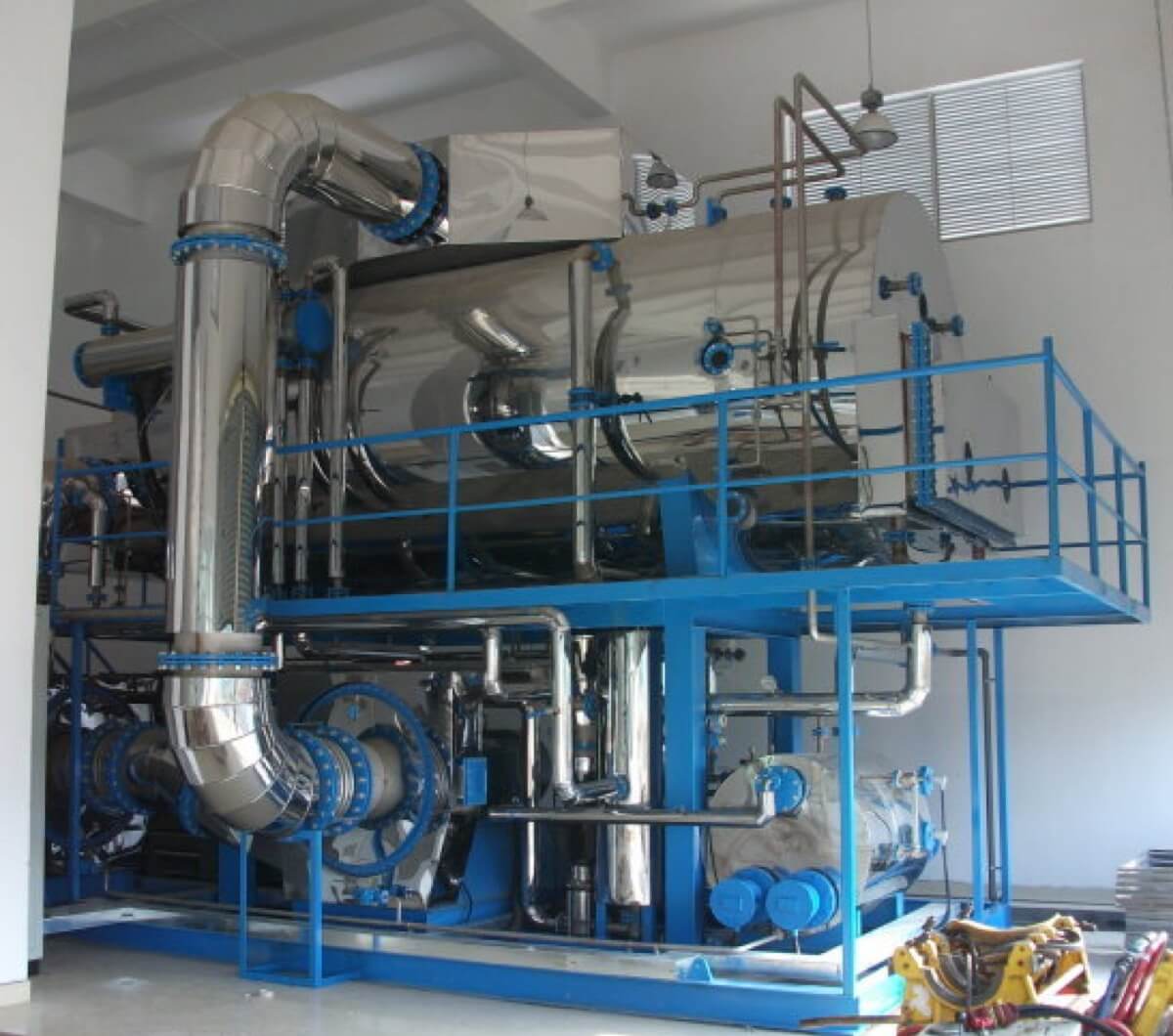
Selecting the wrong vacuum generation method guarantees operational failure. Liquid ring pumps offer excellent tolerance for vapor carryover and particulates. However, they require a continuous supply of seal liquid, which operators must manage or cool. If the seal water gets too hot, the pump loses its ability to pull a deep vacuum. Dry screw pumps provide deep, clean vacuum without seal fluids, but they remain highly sensitive to sticky particulates or liquid slugs entering the casing. Steam ejectors handle massive vapor loads with no moving parts, yet they demand a constant supply of motive steam.
Plant engineers must evaluate process fluid compatibility before specifying the pump. The maintenance burden also requires careful planning. Oil contamination in rotary vane pumps, seal degradation from acidic vapors, and unexpected mechanical downtime can cripple production schedules. Implementing strict preventative maintenance schedules prevents these catastrophic failures. You must monitor pump vibration, check seal water temperatures daily, and inspect exhaust lines for signs of product carryover.
Operating under negative pressure introduces unique mechanical stresses. Unlike pressurized tanks that risk outward explosion, vacuum vessels face severe implosion risks. The external atmospheric pressure constantly attempts to crush the vessel inward. Engineers must design the boiling chamber with adequate wall thickness and external reinforcing rings to meet strict ASME pressure vessel codes. A dented or compromised vessel wall under vacuum can lead to immediate structural collapse.
Material compatibility presents another major hurdle. Corrosive vapors behave differently at low pressures. Chlorides, fluorides, and low-pH compounds will rapidly destroy standard 304 or 316 stainless steel through pitting and chloride stress corrosion cracking. Specifying appropriate alloys remains non-negotiable for long-term reliability. Depending on the chemical profile, engineers must utilize Titanium Grade 2, Hastelloy C276, or specialized fluoropolymer coatings. While these materials increase initial capital costs, they prevent catastrophic leaks and ensure decades of reliable operation in harsh industrial environments.
The operating pressure of a vacuum evaporator dictates the thermal efficiency of the entire system. It controls the boiling temperature, safeguards product quality, and determines the physical size of the heat exchangers required. Buyers should specify equipment based on a rigorous analysis of their fluid's Boiling Point Elevation curve, the availability of low-grade facility heat, and the strict thermal degradation limits of their product.
Execute the following steps to ensure successful system implementation:
Conduct a laboratory-scale pilot test with an equipment manufacturer to map the exact pressure-to-temperature curve for your specific fluid.
Measure the fluid's viscosity changes at different concentration levels to properly size the internal scrapers and positive displacement discharge pumps.
Audit your facility for available low-grade waste heat sources, such as compressor exhaust or cooling tower return water, that can be repurposed to drive the evaporation process.
Verify the vaporization rates and final concentrate yield during a continuous 240-minute batch cycle before committing to full-scale capital expenditure.
A: A vacuum lowers the internal atmospheric pressure within the vessel. Because boiling occurs when a liquid's vapor pressure equals the surrounding pressure, reducing the environmental pressure allows the liquid to boil at a much lower temperature. This drastically reduces the thermal energy required to initiate vaporization.
A: Standard industrial vacuum evaporators typically operate between 30 and 300 mbar. The exact setpoint depends on the technology used, such as mechanical vapor recompression or heat pump systems, and the target boiling temperature required to protect the specific process fluid from thermal degradation.
A: As a fluid concentrates, the density of dissolved solids increases, requiring more heat to boil. This is Boiling Point Elevation. Operating under a vacuum helps offset this phenomenon by keeping the baseline boiling temperature low enough to maintain a viable temperature differential for continuous heat transfer.
A: Lowering the pressure removes the thermal barrier to boiling, but it does not directly dictate the speed. The actual evaporation rate is primarily determined by the total heating power supplied, the fluid's thermal conductivity, and the overall heat transfer coefficient of the system.
A: The primary maintenance challenges include managing vacuum pump wear, maintaining airtight mechanical seals to prevent pressure leaks, and mitigating scaling or fouling on the heat exchanger surfaces. Regular inspection of condenser efficiency is also critical to prevent vapor carryover into the pump.
A: Vacuum evaporation prevents thermal degradation by allowing liquids to boil at temperatures often below 40°C. This low-temperature processing preserves essential organoleptic properties, including delicate flavors, natural colors, vitamins, and active nutritional ingredients, while preventing unwanted Maillard reactions.

