
Views: 0 Author: Site Editor Publish Time: 2026-08-10 Origin: Site


Escalating regulatory pressure for Zero Liquid Discharge (ZLD) in lithium-ion battery manufacturing and hydrometallurgical recycling demands immediate attention. Plant managers face complex, highly saline wastewater streams that pose severe compliance and operational hurdles. Processing this wastewater directly impacts overall plant operating expenses. Thermal separation remains a highly energy-intensive process. Selecting the wrong evaporation technology leads to unsustainably high utility costs. It also causes frequent maintenance downtime due to severe scaling and risks failure to meet strict discharge compliance. Industrial facilities primarily rely on three dominant solutions to tackle these challenges: MVR Evaporator systems, Multi-effect Evaporator units, and Heat-pump Evaporator packages. The optimal choice depends on a strict evaluation of site utility constraints, feed stream chemistry, and capital versus operational expenditure thresholds.
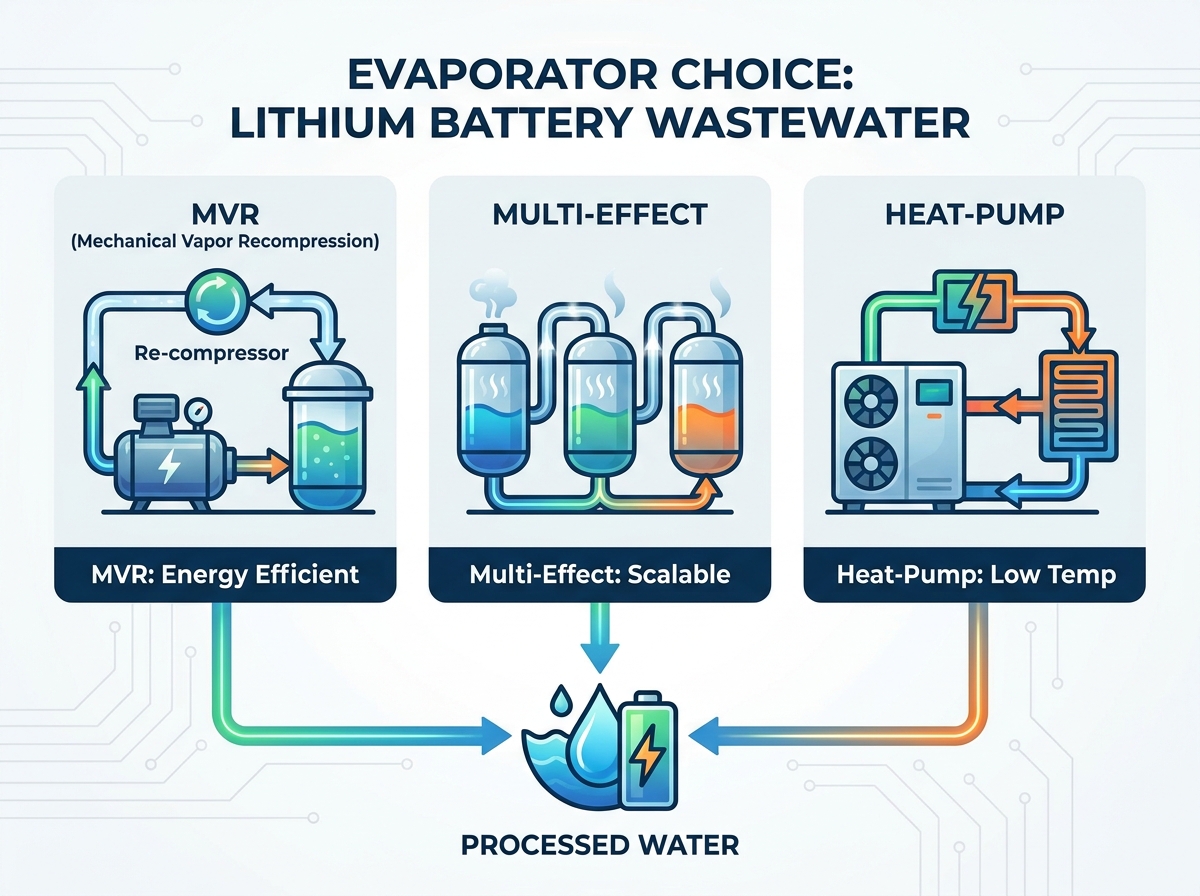
MVR Evaporators offer the lowest long-term OPEX by recycling vapor energy (yielding 30-50% energy savings over traditional methods), making them ideal for high-capacity facilities with stable, affordable electricity, despite higher initial CAPEX.
Multi-Effect Evaporators (MEE) remain the most viable solution for facilities with abundant, low-cost waste steam and for treating wastewater with extreme boiling point elevations or high viscosities.
Heat-Pump Evaporators provide a low-temperature, highly efficient solution for smaller volumes or thermally sensitive streams, operating entirely on electricity without requiring external steam or cooling water.
Material selection and pre-treatment are critical across all systems; the corrosive nature of lithium battery wastewater (chlorides, heavy metals) dictates the use of high-grade alloys and rigorous anti-fouling strategies.
Evaporation Crystallization is the mandatory final step for true ZLD in battery recycling, requiring careful integration with the primary evaporation system to recover valuable battery-grade salts.
Table of Contents
Battery recycling and production streams contain highly complex contaminants. Extracting valuable metals leaves behind challenging chemical byproducts. You will find residual lithium, cobalt, nickel, and manganese in these streams. These metals exist alongside massive concentrations of sodium sulfate or sodium chloride. These aggressive chemistries contribute directly to severe scaling and fouling. Scaling forms hard mineral deposits on heat transfer surfaces inside the evaporator. This physical barrier drastically reduces thermal efficiency. It forces unplanned maintenance shutdowns to mechanically or chemically clean blocked tubes.
Certain salts, like sodium sulfate, exhibit inverse solubility. They become less soluble as temperatures rise, making heat exchanger scaling almost inevitable without precise design. Operators must understand the specific scaling mechanisms at play in their facilities. We typically categorize these mechanisms into three distinct types:
Precipitation Scaling: Dissolved salts exceed their solubility limits and crystallize directly onto the hot tube walls.
Particulate Fouling: Suspended solids from upstream processes settle and bake onto the heat transfer surfaces.
Corrosion Fouling: The aggressive chlorides attack the base metal, creating rough surfaces that accelerate further mineral deposition.
Managing these risks requires a combination of high-velocity fluid circulation and strict chemical pre-treatment. If you ignore the chemistry of your feed stream, your evaporator will plug within days of commissioning.

Boiling Point Elevation dictates the thermodynamic limits of your system. BPE defines the temperature difference between boiling pure water and boiling a saline solution at the exact same pressure. High-salinity battery wastewater significantly raises the boiling point. This physical property dictates fundamental evaporator design. High BPE directly impacts the energy efficiency of your chosen system. It also determines the mechanical requirements for vapor compressors.
When BPE increases, the effective temperature difference across the heat exchanger drops. To compensate, the system must operate at higher pressures or utilize larger heat transfer areas. Systems must work significantly harder to compress vapor when BPE reaches extreme levels. A feed stream with a 10°C BPE requires a compressor pressure ratio that pushes the limits of standard single-stage centrifugal fans. Failing to account for BPE leads to stalled evaporation, surging compressors, and rapid equipment failure. Engineers must map the BPE curve of the specific wastewater from zero concentration all the way to saturation.
Evaporation goes beyond simple waste volume reduction. It serves as a mandatory step in resource recovery. Facilities must transition from standard liquid concentration to full evaporation crystallization. This transition allows plants to successfully harvest valuable salts in solid form. It achieves the true closed-loop water systems required for ZLD compliance.
Standard falling film evaporators handle the initial concentration phase efficiently. However, they cannot handle the heavy slurries generated during crystallization. You must deploy forced circulation crystallizers for the final stage. These units use massive axial flow pumps to push the supersaturated brine through the heat exchangers at high velocities. This prevents boiling inside the tubes, forcing the evaporation to occur only in the flash vessel. Recovering battery-grade salts turns a waste liability into a potential revenue stream. It ensures you meet strict environmental regulations while maximizing overall resource efficiency.
Mechanical Vapor Recompression represents the standard for electrical efficiency. The system uses a mechanical compressor, often a centrifugal fan or Roots blower, to compress secondary vapor. This compression increases the vapor's temperature and pressure. The system then reuses this compressed vapor as the primary heating medium. This utility profile requires highly stable electrical power for the compressor. It needs minimal live steam, usually only during initial startup sequences to bring the system up to operating temperature.
An MVR Evaporator reduces new steam consumption by up to 50% compared to traditional methods. This technology fits best in high-volume continuous processing environments. Local electricity rates must be cost-effective compared to steam generation. The feed stream must also lack volatile organics. Volatile compounds can cause severe mechanical damage to high-speed compressor internals. If organics carry over into the vapor phase, they can degrade the compressor seals or create explosive conditions inside the casing.
Multi-Effect Evaporators utilize multiple connected vessels, known as effects. Vapor generated from the first effect serves as the heating medium for the second. Each subsequent vessel operates at successively lower pressures. This pressure drop maintains the necessary temperature driving force across the entire system. Engineers configure these systems in forward feed, backward feed, or parallel feed arrangements depending on the viscosity and temperature sensitivity of the brine.
Thermal Vapor Recompression (TVR) frequently integrates with MEE setups. TVR uses high-pressure motive steam to entrain and compress a portion of the secondary vapor. This improves overall steam efficiency without demanding a massive mechanical compressor. A Multi-effect Evaporator demands high volumes of industrial steam. It also requires substantial cooling water infrastructure to condense the final vapor. It fits perfectly for facilities possessing existing cogeneration plants. It excels when treating feed streams with massive BPE and high dynamic viscosity. These extreme conditions easily exceed standard MVR compressor limits.
Heat-Pump Evaporators use a closed-loop refrigeration cycle to separate water from contaminants. A dedicated compressor circulates a refrigerant through an evaporator and a condenser. The system evaporates wastewater at very low temperatures. Operations typically run between 30°C and 40°C under a strict vacuum. The utility profile relies entirely on electrical operation. You do not need external plant steam or a large cooling tower.
A Heat-pump Evaporator provides an ideal fit for low-to-medium volume applications. It works exceptionally well for decentralized wastewater treatment facilities. It also excels when streams contain volatile organics. Low-temperature separation prevents thermal degradation and stops volatile carryover into the clean distillate. The low operating temperature also allows for the use of less expensive construction materials in certain non-chloride applications, though battery wastewater still demands high-grade alloys.
Specific energy consumption varies drastically across the three thermal technologies. MVR systems typically consume between 15 to 30 kWh per ton of evaporated water. Heat-pump systems consume slightly more electrical power due to the mechanical demands of the refrigeration cycle. MEE relies heavily on boiler steam. A standard triple-effect MEE consumes roughly 0.33 tons of steam per ton of evaporated water.
Your decision framework must center entirely on site utility availability. Evaluate your local grid stability against your existing boiler capacity. Do not select an electrically driven system if your local power grid experiences frequent brownouts or voltage drops. A sudden power loss will trip the MVR compressor, potentially causing mechanical damage and forcing a lengthy restart sequence.
Technology | Primary Energy Source | Specific Energy Consumption | Best Application Fit |
|---|---|---|---|
MVR Evaporator | Electricity | 15 - 30 kWh / ton water | High volume, low BPE, stable grid |
Multi-Effect Evaporator (Triple Effect) | Industrial Steam | ~0.33 tons steam / ton water | High BPE, high viscosity, cheap steam |
Heat-Pump Evaporator | Electricity | 40 - 60 kWh / ton water | Low volume, low temperature needs |
Each system handles increasing viscosity and suspended solids quite differently. Standard MVR falling film designs struggle with highly viscous, near-saturation slurries. When fluid viscosity exceeds 50 centipoise, film thickness increases inside the tubes. This reduces heat transfer efficiency and creates a high risk of complete tube blockages. The liquid distribution system at the top of the falling film tubes will plug if suspended solids exceed design limits.
MEE shows clear superiority in handling these challenging fluid dynamics. Forced circulation MEE designs easily manage heavy slurries. High-volume circulation pumps push the fluid past standard crystallization limits without plugging. The high tube velocity shears away boundary layers and prevents localized boiling. Heat-pump systems handle moderate viscosities well. However, they excel primarily in preventing thermal degradation of heat-sensitive compounds rather than handling heavy crystal slurries.
Physical footprint requirements dictate critical plant layout decisions. MEE requires significant vertical space to accommodate multiple tall vessels and barometric condensers. It also demands extensive external cooling infrastructure, including large cooling towers and circulation pumps. Heat-pump systems are often highly compact. Manufacturers typically deliver them skid-mounted for rapid, plug-and-play deployment. You can install them in tight spaces with minimal civil engineering work.
MVR requires dedicated floor space for large mechanical compressors. It also needs specialized noise-dampening enclosures to protect operators from high-decibel equipment. Automation capabilities dictate your daily operator intervention levels. MVR and Heat-pump systems support highly automated, continuous processing through modern Programmable Logic Controllers (PLCs). They utilize advanced SCADA systems to monitor compressor vibration, bearing temperatures, and liquid levels. MEE often requires more manual oversight during startup sequences and batch processing transitions.
Upfront capital costs rank differently across the three technologies. MVR generally carries the highest initial price tag. This stems from the precision mechanical compressor and the massive heat transfer area required to operate on small temperature differentials. The compressor itself often accounts for a massive portion of the total equipment cost. Heat-pump systems represent a moderate capital investment for smaller capacities, as the refrigeration components are standardized and widely available.
MEE costs remain highly variable based on specific design choices. The final MEE price depends entirely on the number of effects installed. Adding a fourth or fifth effect increases the CAPEX but lowers the steam consumption. Including TVR components or upgrading from falling film to forced circulation also shifts the initial capital requirement. You must balance the cost of additional heat exchanger surface area against the available steam pressure.
Comparative analysis over a 10-year lifecycle reveals distinct financial trajectories. The MVR system's massive energy savings often yield a rapid return on investment. This operational efficiency quickly offsets the steep initial price tag in high-capacity plants. Facilities operating 24/7 often achieve payback on the MVR premium within two to three years. The electrical efficiency dominates the OPEX calculation.
MEE operational expenses fluctuate directly with local fossil fuel prices. Boiler fuel costs dictate the long-term viability of steam-driven systems. If natural gas or coal prices spike, the MEE OPEX becomes a severe burden. Heat-pump operational expenses remain highly predictable. They tie strictly to commercial electricity rates and require minimal consumable chemicals. You do not need to purchase cooling tower water treatment chemicals or boiler feed water additives.
Equipment upkeep demands specific technical resources and planned downtime. MVR maintenance involves replacing expensive compressor seals on a strict schedule. Operators must also conduct rigorous, continuous vibration monitoring to prevent catastrophic mechanical failures. Oil analysis and bearing replacements require specialized technicians. If an MVR compressor fails, the entire evaporation plant goes offline.
MEE maintenance focuses heavily on servicing large vacuum systems and circulation pumps. Technicians spend significant hours chemically cleaning scaled tubes and managing cooling tower water chemistry. You must regularly inspect the barometric condensers and steam ejectors for wear. Heat-pump systems require specialized servicing of closed-loop refrigeration circuits. You must hire certified HVAC technicians for periodic refrigerant compressor overhauls and leak detection. Replacing lost refrigerant adds to the lifecycle maintenance burden.

Lithium wastewater presents a severe corrosion risk due to high chloride concentrations. Standard 316L stainless steel fails rapidly in these aggressive, high-temperature environments. You must upgrade construction materials based on operating temperatures and specific chloride levels. Skimping on metallurgy guarantees premature equipment failure and massive replacement costs.
Titanium, Super Duplex stainless steels, or Hastelloy become absolutely mandatory for long-term reliability. Grade 2 or Grade 12 Titanium offers excellent resistance to crevice corrosion. Proper material selection prevents catastrophic pitting and stress corrosion cracking. You must also consider the materials used for the circulation pumps, valves, and instrumentation wetted parts.
Chloride Concentration (ppm) | Operating Temperature | Recommended Material |
|---|---|---|
< 500 ppm | < 60°C | 316L Stainless Steel |
500 - 5,000 ppm | 60°C - 80°C | 2205 Duplex Stainless Steel |
> 5,000 ppm | > 80°C | Titanium Grade 2 / Hastelloy C276 |
Raw battery wastewater cannot enter an evaporator directly without causing immediate problems. You must implement rigorous upstream filtration to remove suspended solids. Ultrafiltration or multimedia filters catch the fine particulates that would otherwise bake onto the heat exchangers. pH adjustment neutralizes aggressive acids or bases before they hit the system, protecting the metallurgy from extreme pH excursions.
Chemical softening using sodium carbonate or sodium hydroxide removes calcium and magnesium ions from the raw feed. These hardness ions form the most stubborn scales. These pre-treatment steps prevent premature scaling. They protect the expensive evaporator heat exchangers from irreversible fouling and maintain optimal thermal efficiency throughout the production cycle. A well-designed pre-treatment system extends the time between chemical cleaning cycles from days to months.
MVR compressors face distinct operational limits that you must respect. Unexpected spikes in Boiling Point Elevation cause severe compressor surging. Surging occurs when the compressor cannot overcome the pressure differential, causing violent flow reversals that destroy bearings and impellers. Volatile organic carryover can cause catastrophic mechanical failure by degrading compressor seals or causing internal explosions.
You can mitigate this risk by designing intelligent hybrid systems. Use the MVR to handle the bulk concentration of the wastewater where BPE remains low. Follow this with a steam-driven single-effect crystallizer for the final high-BPE stage. This protects the sensitive compressor while maximizing overall plant energy efficiency. You should also install variable frequency drives (VFDs) and automated surge control valves to protect the compressor during startup and shutdown sequences.
Initiate a comprehensive feed stream characterization and laboratory pilot testing program to determine exact boiling point elevations and scaling tendencies.
Consult with a specialized thermal separation engineer to develop a localized lifecycle cost analysis based on your specific utility rates.
Evaluate your facility's long-term utility expansion plans to ensure adequate electrical grid stability or boiler steam capacity.
Define your exact zero liquid discharge requirements and final salt purity targets to properly size the downstream crystallization equipment.
For high-salinity wastewater, resource recovery, and ZLD projects, VNOR develops and supplies customized evaporation and crystallization systems using MVR, multi-effect, and heat-pump technologies. Its project support covers system design, fabrication, installation and commissioning, and after-sales service, helping industrial facilities balance energy efficiency, operational reliability, and lifecycle cost.
A: Multi-effect systems rely heavily on industrial steam and cooling water to drive the separation process. MVR shifts this reliance entirely to electrical power by using a mechanical compressor to recycle vapor heat. This fundamental difference yields 30-50% energy savings for MVR. MVR typically consumes 15-30 kWh per ton of evaporated water, drastically lowering utility bills compared to steam-driven alternatives.
A: A Heat-pump system acts as an excellent low-temperature concentrator, but it rarely achieves true ZLD on its own. It struggles with the extreme viscosities and high boiling point elevations found in the final crystallization stages of battery recycling. You must pair it with a dedicated crystallizer or specialized drying equipment to successfully harvest dry salts and achieve complete zero liquid discharge.
A: High boiling point elevation (BPE) forces the MVR compressor to work significantly harder to maintain the necessary temperature differential. Extreme BPE requires higher compressor pressure ratios, which increases electrical consumption and mechanical stress. When BPE exceeds standard limits, engineers must deploy multi-stage compressors or design hybrid MEE-MVR systems to handle the concentrated brine safely.
A: The evaporation method matters less than the metallurgy. Lithium chloride wastewater is exceptionally aggressive, causing rapid pitting in standard stainless steel. All evaporator types must be constructed using high-grade materials like Titanium, Super Duplex stainless steel, or Hastelloy. Selecting the right alloy prevents catastrophic corrosion and ensures long-term operational stability.
A: MVR maintenance centers heavily on the mechanical compressor. Operators must perform strict vibration monitoring, replace mechanical seals, and maintain lubrication systems to prevent high-speed failures. Additionally, heat exchanger scaling requires regular chemical cleaning to maintain thermal efficiency. Proper upstream filtration minimizes these fouling issues and extends the time between maintenance intervals.
A: Yes, hybrid systems offer exceptional efficiency for complex wastewater. The MVR unit handles the bulk volume concentration where boiling point elevation remains low, maximizing electrical efficiency. The Multi-effect unit then takes over the highly concentrated, high-BPE tail end of the process. This protects the MVR compressor from extreme stress while efficiently driving the brine to saturation.
A: TVR serves as a highly effective middle-ground between standard MEE and full MVR. It uses high-pressure motive steam to entrain and compress a portion of the secondary vapor, recycling it back into the heating system. TVR integrates easily into Multi-effect setups to improve overall steam efficiency without requiring the massive capital investment of a mechanical compressor.

