
Views: 0 Author: Site Editor Publish Time: 2026-11-24 Origin: Site


Thermal vapor recompression vs mechanical vapor recompression are two heat recovery technologies used to reduce energy consumption in industrial evaporation and concentration processes. TVR uses high-pressure motive steam and a steam jet thermocompressor to reuse part of the generated vapor, while MVR uses a mechanical compressor, typically driven by an electric motor, to increase vapor pressure and temperature for heat reuse. Both technologies can improve energy efficiency, but their operating costs and suitability depend on available utilities, required temperature lift, boiling point elevation, and evaporation capacity. Understanding these differences helps industrial buyers and process engineers evaluate suitable equipment configurations for their applications.
Utility Dependency: Thermal vapor recompression (TVR) relies on the availability of high-pressure motive steam, whereas mechanical vapor recompression (MVR) utilizes electrical energy, making MVR a primary driver for the electrification of industrial heat.
Thermodynamic Limits: MVR is highly efficient for processes requiring low temperature lifts (ΔT) and low boiling point elevations, while TVR can handle higher compression ratios depending on motive steam pressure.
Financial Trade-offs: TVR offers significantly lower capital expenditure (CAPEX) with a smaller physical footprint, whereas MVR requires high initial CAPEX but delivers drastic reductions in long-term OPEX through the continuous recycling of energy streams.
Implementation Risk: Both systems are highly sensitive to part-load operations and changes in feed composition; rigorous thermodynamic modeling is required prior to specification.
Table of Contents
Evaporation processes consume vast amounts of energy. Water requires massive latent heat to phase change from liquid to vapor. Historically, plant operators rejected this evaporated vapor to cooling towers or condensers. That practice wastes enormous thermal energy. Modern industrial standards demand the capture and reuse of this latent heat. Vapor recovery transforms a waste stream into a valuable heating medium, fundamentally changing the plant's energy balance.
You must establish clear success metrics before selecting a recovery system. Evaluate these primary performance indicators:
Specific Energy Consumption (SEC): Measures the kilograms of steam required to evaporate one kilogram of water. Lower SEC values indicate higher efficiency.
Coefficient of Performance (COP): Compares the useful heat output to the work input required by the compressor.
Evaporation Rate Capacity: Dictates the physical scale of the equipment and the required vapor ducting diameters.
Long-Term Operational Expenditure: Includes initial equipment purchase, installation, maintenance, and decades of utility consumption.
Site-specific constraints dictate project feasibility from day one. Local utility rates play a massive role. A facility with cheap natural gas and expensive electricity evaluates projects differently than one with abundant renewable power. Existing boiler infrastructure also matters. If your plant lacks excess high-pressure steam capacity, certain technologies become impossible to implement. Corporate decarbonization mandates further complicate the decision. Many companies now require absolute reductions in Scope 1 emissions, forcing engineering teams to prioritize electrification over traditional fossil-fuel-driven steam generation.
The technology behind thermal vapor recompression utilizes a steam jet ejector, commonly called a thermocompressor. This static device contains no moving parts. It relies entirely on fluid dynamics to compress vapor. High-pressure motive steam enters the ejector through a converging-diverging nozzle. The nozzle accelerates the steam to supersonic velocities, creating a localized low-pressure zone in the suction chamber.
The low-pressure zone entrains suction vapor from the evaporator separator. The motive steam and suction vapor mix thoroughly in the mixing section. This combined fluid stream then enters the diffuser. The diffuser slows the fluid down, converting kinetic energy back into pressure. The resulting discharge vapor leaves the thermocompressor at a higher pressure and temperature than the original suction vapor. This upgraded vapor then serves as the heating medium for the evaporator heat exchanger. The lack of moving parts ensures exceptional mechanical reliability and minimal downtime.
TVR systems strictly require a reliable supply of high-pressure motive steam. Facilities typically supply this steam at pressures between 3 and 10 bar. Higher motive pressures generally yield better compression performance. The system's efficiency depends heavily on the suction-to-discharge pressure ratio. High compression ratios require more motive steam to entrain the same amount of suction vapor, which decreases the overall entrainment ratio.
The entrainment ratio measures the kilograms of motive steam needed per kilogram of entrained vapor. A higher ratio means lower system efficiency. TVR excels in applications requiring moderate temperature lifts. It fits perfectly for heat-sensitive products. Food and beverage applications often use TVR for vacuum evaporation. The vacuum lowers the boiling point, protecting the product from thermal degradation. The static nature of the thermocompressor handles these vacuum conditions reliably.
Adding TVR to an evaporator drastically improves steam economy. A standard single-effect evaporator requires roughly one kilogram of steam to evaporate one kilogram of water. Integrating a thermocompressor changes this dynamic. Integrating thermal vapor recompression into an evaporation system can improve steam economy by recovering part of the generated vapor for reuse as a heating medium. Depending on the thermocompressor design and operating conditions, the resulting steam savings may be comparable to those achieved by adding evaporation effects. However, the actual improvement should be determined through a mass and energy balance rather than assuming a fixed twofold or threefold increase in efficiency.
Despite these efficiency gains, TVR has a fundamental limitation. It still relies on motive steam. Facilities generate this steam using fossil fuels or biomass in industrial boilers. Therefore, TVR directly contributes to Scope 1 greenhouse gas emissions. It improves energy efficiency but does not eliminate carbon output. Facilities aiming for complete decarbonization often find TVR insufficient for their long-term sustainability goals. It serves as an excellent optimization tool but not a complete energy transition solution.
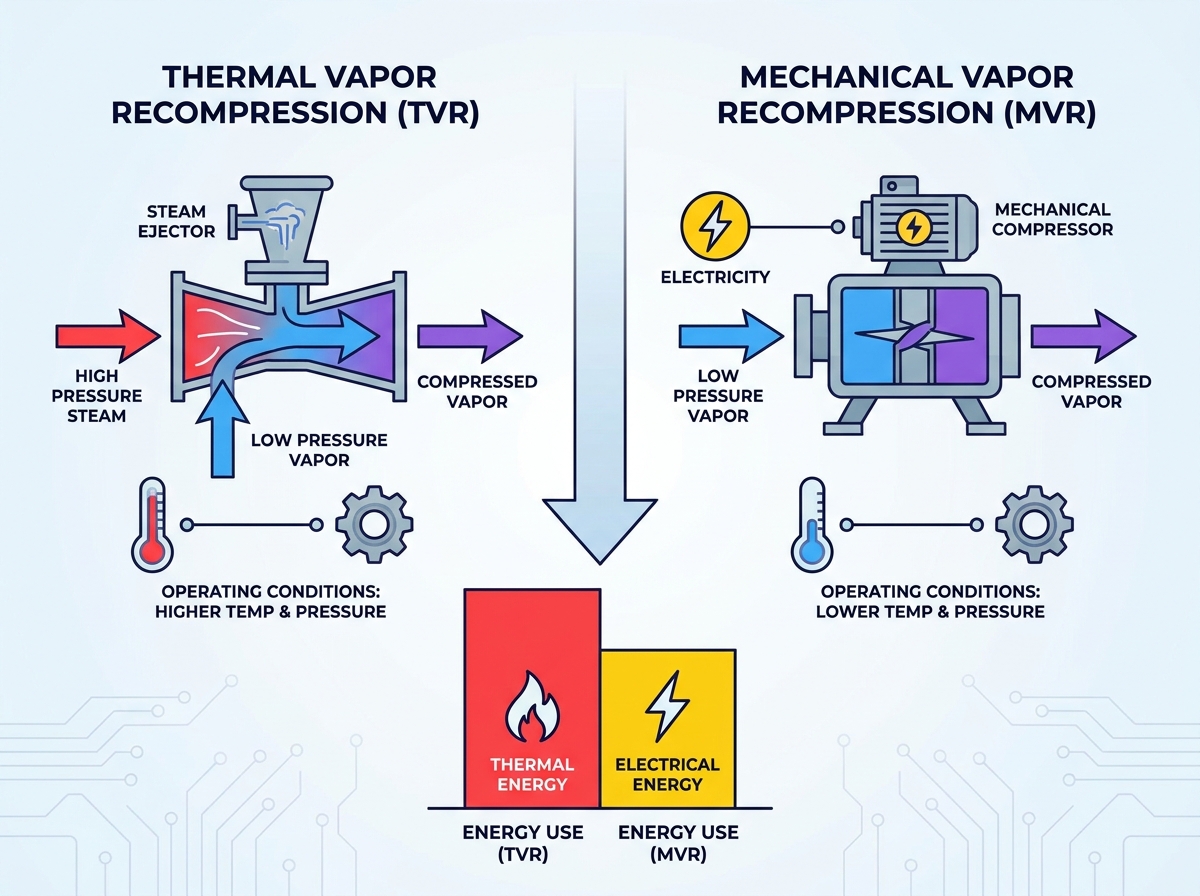
Mechanical vapor recompression operates on a completely different thermodynamic principle. It uses mechanical energy to increase the pressure and temperature of process vapor. Electric motors drive large centrifugal fans or advanced turbo compressors. The evaporator boils the feed liquid, generating low-pressure vapor. The compressor draws in this vapor and applies mechanical work to it. This work increases the vapor's enthalpy.
The compressed, higher-temperature vapor then flows back into the evaporator's main heat exchanger. It condenses on the heating surfaces, transferring its latent heat to the incoming feed liquid. This creates a continuous, closed-loop energy cycle. The compressed vapor serves as the sole heating medium for the process. Once the system reaches steady-state operation, it requires virtually no external heating steam. The electric motor provides all the necessary energy to maintain the evaporation cycle.
MVR systems possess a specific thermodynamic sweet spot. They excel in continuous operations with high evaporation capacities. The technology is most efficient when the required temperature lift remains low. The required temperature lift should be determined according to the boiling point elevation, heat transfer temperature difference, system pressure losses, and available compressor technology. Different compressor types and single-stage or multi-stage configurations offer different operating ranges, so the allowable temperature lift must be confirmed against the manufacturer's performance data. Low temperature lifts require less mechanical work from the compressor. This keeps electrical power consumption to a minimum.
Boiling Point Elevation (BPE) heavily impacts MVR feasibility. BPE occurs when dissolved solids increase the boiling temperature of a liquid above that of pure water. High BPE fluids require a higher condensing temperature to maintain heat transfer. This forces the compressor to achieve a higher temperature lift. High lifts push single-stage compressors to their mechanical limits. They increase power consumption and often require expensive multi-stage compressor configurations. Therefore, MVR works best with low-BPE solutions like wastewater or dilute dairy products.
MVR delivers an exceptionally high Coefficient of Performance. Industry experts recognize it as the most energy-efficient evaporation technology available today. A well-designed MVR system yields the thermal equivalent of 10 to 30 effects in a traditional steam evaporator. It requires only a fraction of the energy input compared to conventional systems. The electrical energy powers the compressor, which simply upgrades existing latent heat rather than generating new heat from scratch.
This high efficiency makes MVR a cornerstone technology for industrial decarbonization. It enables the direct electrification of industrial heat. Electrically driven MVR systems can support industrial decarbonization by reducing the need for steam generated from on-site fossil-fuel boilers. Their overall emissions impact depends on the electricity source, remaining auxiliary heating requirements, and system operating conditions. When combined with low-carbon electricity and suitable plant infrastructure, MVR can help reduce the carbon footprint of industrial evaporation processes.
Operating expenditure differs fundamentally between the two technologies. TVR OPEX depends entirely on the cost of generating high-pressure steam. You must factor in boiler fuel costs, boiler feedwater treatment, and steam distribution losses. MVR OPEX depends on industrial electricity rates. The compressor motor runs continuously, drawing significant electrical power.
Evaluating these costs requires calculating a break-even point. You must compare the local ratio of electricity prices to natural gas or biomass fuel prices. If electricity is exceptionally expensive and boiler fuel is cheap, TVR often maintains a lower OPEX. However, as renewable energy expands and grid electricity becomes cheaper, MVR increasingly wins the OPEX battle. You must project these utility rates over a 10-to-15-year horizon to make an accurate assessment.
Technical limits regarding temperature lift strongly influence system selection. TVR achieves moderate to high temperature lifts, provided sufficient motive steam pressure exists. The static nozzle design handles varying compression ratios well, though efficiency drops at higher lifts. MVR faces strict mechanical limits. Standard centrifugal fans max out at relatively low temperature lifts. They move massive volumes of vapor but cannot generate high pressure differentials.
Higher temperature lift requirements can increase the compression duty and operating costs of an MVR system. The achievable temperature lift depends on compressor type, pressure ratio, vapor flow rate, and the number of compression stages. For processes with significant boiling point elevation, engineers should evaluate the compressor operating range and overall energy requirements before selecting MVR. TVR may provide an alternative when suitable motive steam is available, but its performance is also limited by suction pressure, discharge pressure, and steam consumption. The final technology choice should be based on process calculations, utility availability, and lifecycle cost comparisons rather than assuming that either system is universally superior for high-temperature-lift applications.
The capital cost components for both systems present a stark contrast. TVR requires minimal initial investment. A thermocompressor is a relatively inexpensive piece of static equipment. It requires basic piping modifications and standard control valves. The installation is straightforward and fast. MVR, conversely, demands massive initial capital. Turbo compressors require precision engineering. They often utilize expensive materials like titanium or super duplex stainless steel to prevent corrosion and withstand high rotational speeds.
MVR also requires upgraded electrical infrastructure. You must install heavy-duty cabling, large transformers, and sophisticated Variable Frequency Drives (VFDs). Despite this high CAPEX, MVR delivers massive OPEX savings. You must model typical payback periods to justify the investment. MVR systems generally achieve a payback period of two to five years based on energy savings alone. The long-term financial benefits heavily outweigh the initial sticker shock for continuous, high-capacity operations.
Maintenance requirements differ drastically. TVR's static nature means it requires near-zero maintenance. Operators only need to perform periodic visual inspections of the nozzle for erosion or scaling. MVR requires rigorous, specialized mechanical maintenance. Compressors operate at high speeds. They require continuous vibration monitoring, precise bearing lubrication, and periodic mechanical seal replacements. A compressor failure halts the entire production line.
Physical footprint also impacts system selection. TVR is incredibly compact. You can easily retrofit a thermocompressor into existing facility layouts or pipe racks. MVR requires significant floor space. The compressor, motor, VFD cabinets, and extensive large-diameter vapor ducting consume valuable real estate. Retrofitting MVR into a tight, legacy plant layout often requires structural modifications and complex engineering workarounds.
Evaluation Criteria | Thermal Vapor Recompression (TVR) | Mechanical Vapor Recompression (MVR) |
|---|---|---|
Energy Source | High-pressure motive steam | Electrical power |
Primary OPEX Driver | Boiler fuel costs (Gas/Biomass) | Industrial electricity rates |
Capital Expenditure (CAPEX) | Low (Static equipment) | High (Rotating machinery, VFDs) |
Maintenance Intensity | Very Low (No moving parts) | High (Bearings, seals, vibration) |
Temperature Lift Capability | Moderate to High (Depends on motive steam) | Low to Moderate (Depends on compressor stages) |
Decarbonization Impact | Low (Relies on fossil/biomass boilers) | High (Enables full electrification) |
Physical Footprint | Compact and easy to retrofit | Large (Requires heavy ducting and motor space) |
Evaporator fouling presents a severe risk to vapor recovery systems. As liquids concentrate, dissolved solids precipitate and bake onto the heat exchanger tubes. This progressive fouling reduces the overall heat transfer coefficient. The system must compensate for this loss of efficiency. In an MVR system, the compressor must work harder to generate a higher temperature lift. This pushes the compressor toward its surge limit and increases electrical draw.
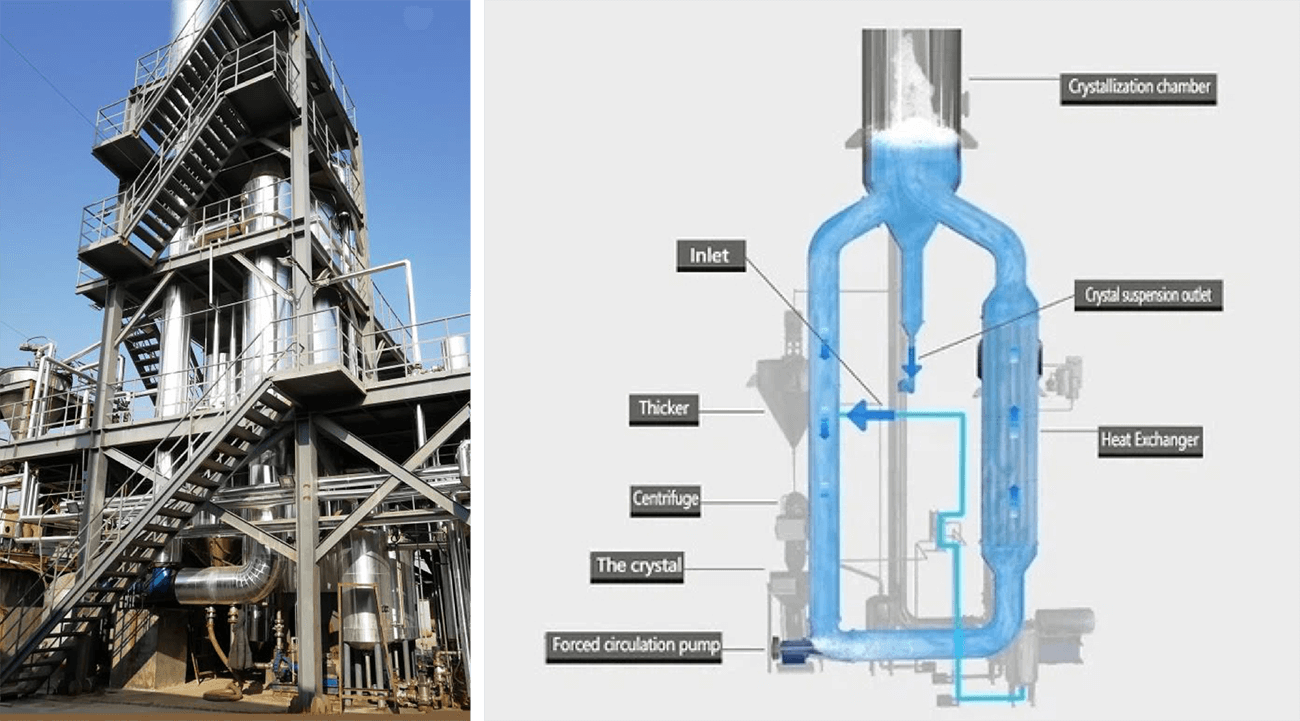
Implement strict mitigation strategies during the design phase. Engineers must utilize conservative heat exchanger sizing to account for fouling factors. Forced circulation designs help maintain high tube velocities, sweeping solids away before they adhere to surfaces. You must also schedule frequent Clean-in-Place (CIP) cycles. Regular cleaning prevents hard scale formation and keeps the compressor operating within its optimal thermodynamic window.
Industrial processes rarely operate at steady-state design conditions forever. Feed rates fluctuate. Product concentrations vary. Both TVR and MVR systems struggle with inflexibility under varying loads. Thermocompressors lose efficiency rapidly when operating off-design. If the suction vapor flow drops, the fixed nozzle geometry cannot adjust. The motive steam simply blows through without entraining enough vapor, destroying the steam economy.
Part-load performance depends on the compressor type and operating range. Centrifugal compressors may encounter surge when vapor flow falls below their stable operating limits, potentially causing pressure fluctuations, vibration, and mechanical damage. Other compressor technologies have different low-load operating characteristics and control requirements. Appropriate capacity control and protection measures should therefore be designed according to the selected compressor's performance data. You must engineer solutions for part-load operation. For TVR, variable geometry nozzles or parallel ejector setups provide turndown capability. For MVR, VFDs allow motor speed adjustments. Engineers also design bypass loops to recirculate vapor, keeping the compressor safely away from surge conditions during low-feed scenarios.
You do not always have to choose exclusively between the two technologies. Many advanced facilities deploy hybrid systems to optimize both CAPEX and OPEX. A common strategy uses MVR for the bulk evaporation phase. The feed liquid starts dilute, meaning BPE remains low. The MVR compressor easily handles the massive vapor volumes with minimal power consumption, removing 80% to 90% of the water highly efficiently.
As the liquid concentrates in the final stages, the BPE spikes. The required temperature lift exceeds the MVR compressor's capability. At this point, engineers route the concentrated liquid to a finishing effect powered by TVR or traditional live steam. This hybrid approach leverages MVR for bulk energy savings while using the robust, high-lift capability of TVR for the difficult finishing work. It prevents the need for expensive multi-stage compressors while still achieving massive overall utility reductions.
Execute the following steps to advance your vapor recovery project:
Initiate a formal pinch analysis of your facility to map all available waste heat streams and baseline energy consumption.
Conduct a 10-year utility projection comparing local industrial electricity rates against boiler fuel availability.
Sample your feed liquid to plot its exact Boiling Point Elevation curve across all target concentration levels.
Partner with an evaporation technology vendor to run preliminary mass and energy balance models for both system types.
A: The primary difference lies in the energy source. TVR uses high-pressure motive steam via a static jet ejector to entrain and compress vapor. MVR uses electrical power to drive a mechanical fan or turbo compressor. MVR continuously recycles the energy stream without requiring fresh heating steam.
A: Higher boiling point elevation increases the temperature difference required for evaporation and may raise the compression duty of an MVR system. TVR can be considered when suitable motive steam is available, but its performance also depends on the pressure conditions and entrainment characteristics. Buyers should compare both technologies using the actual BPE curve, required evaporation capacity, utility costs, and compressor or thermocompressor performance data.
A: No. TVR strictly requires a continuous, reliable supply of high-pressure motive steam to function. The thermocompressor cannot operate without this motive force, meaning existing boiler infrastructure is absolutely mandatory for implementation.
A: While highly variable based on scale and utility rates, MVR systems typically see a payback period of 2 to 5 years. This rapid payback relies on massive OPEX savings, provided the local cost of electricity is favorable compared to boiler fuel.
A: Both systems have distinct limitations off-design. However, MVR equipped with Variable Frequency Drives (VFDs) and bypass loops generally offers slightly better turndown capabilities than standard fixed-nozzle TVR systems. Both technologies operate most efficiently at steady-state design conditions.
A: TVR maintenance is negligible due to a complete lack of moving parts. MVR requires specialized, ongoing maintenance for high-speed rotating equipment. This includes regular bearing lubrication, mechanical seal replacement, and continuous vibration analysis to prevent catastrophic failures.

